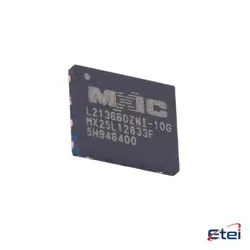
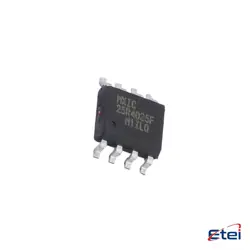
Abbildungen dienen nur als Referenz
24FC256T-I/SN
+StücklisteIC EEPROM 256KBIT I2C 1MHZ 8SOIC
-
HerstellerMikrochip-Technologie
-
Herstellerteil #24FC256T-I/SN
-
Datenblatt 24FC256T-I/SN DataSheet
-
Auf Lager6666
365 Tage Qualitätsgarantie
7*24 Stunden-Servicegarantie
90-Tage Kundendienstgarantie
Originalproduktgarantie
Spezifikationen
| Attribut | Wert |
| PartStatus | Active |
| DigiKeyProgrammable | Verified |
| MemoryType | Non-Volatile |
| MemoryFormat | EEPROM |
| Technology | EEPROM |
| MemorySize | 256Kbit |
| MemoryOrganization | 32K x 8 |
| MemoryInterface | I2C |
| WriteCycleTime-Word,Page | 5ms |
| Voltage-Supply | 1.7V ~ 5.5V |
| OperatingTemperature | -40°C ~ 85°C (TA) |
| MountingType | Surface Mount |
| Package/Case | 8-SOIC (0.154", 3.90mm Width) |
| SupplierDevicePackage | 8-SOIC |
| BaseProductNumber | 24FC256 |
| ClockFrequency | 1 MHz |
| AccessTime | 400 ns |
Übersicht
Description
Key features include:
- Memory organization: 32,768 x 8 bits, with 128 pages of 64 bytes each.
- Data retention: 100 years at 25°C.
- Endurance: Up to 1 million write cycles.
- Low power consumption: Ideal for battery-operated devices.
The 24FC256T-I/SN is available in various packages, including SOIC and TSSOP, facilitating versatile board-level integration. It is commonly used for data storage in applications such as configuration settings, calibration data, and other non-volatile memory needs.
Equivalent
Pinout
1. VCC: Power supply pin (typically +2.5V to +5.5V).
2. GND: Ground pin.
3. SDA: Serial Data Line for data input/output.
4. SCL: Serial Clock Line for synchronizing data transfers.
5. WP: Write Protect pin; when held high, it prevents writing to the memory.
6. A0: Address pin 0 for selecting one of multiple devices on the same bus (optional).
7. A1: Address pin 1 for additional device selection (optional).
8. A2: Address pin 2 for further device selection (optional).
The 24FC256T-I/SN is commonly used for non-volatile data storage in various applications.
Manufacturer
Application
1. Data Storage: For storing configuration settings, calibration data, and user preferences in embedded systems.
2. Consumer Electronics: In devices like TVs, audio systems, and appliances for firmware updates and settings retention.
3. Automotive: For storing diagnostic data, vehicle configuration, and infotainment settings.
4. Industrial Automation: In PLCs and sensors for logging data and storing parameters.
5. Medical Devices: For patient data storage and device calibration.
Its I2C interface allows easy integration with microcontrollers in these applications.