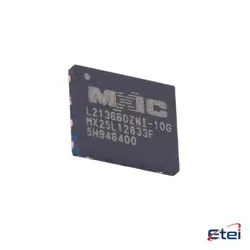
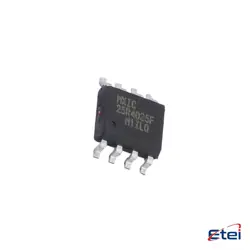
Abbildungen dienen nur als Referenz
93LC56C-I/SN
+StücklisteIC EEPROM 2KBIT MICROWIRE 8SOIC
-
HerstellerMikrochip-Technologie
-
Herstellerteil #93LC56C-I/SN
-
Datenblatt 93LC56C-I/SN DataSheet
-
Auf Lager9021
365 Tage Qualitätsgarantie
7*24 Stunden-Servicegarantie
90-Tage Kundendienstgarantie
Originalproduktgarantie
Spezifikationen
| Attribut | Wert |
| PartStatus | Active |
| DigiKeyProgrammable | Not Verified |
| MemoryType | Non-Volatile |
| MemoryFormat | EEPROM |
| Technology | EEPROM |
| MemorySize | 2Kbit |
| MemoryOrganization | 256 x 8, 128 x 16 |
| MemoryInterface | Microwire |
| WriteCycleTime-Word,Page | 6ms |
| Voltage-Supply | 2.5V ~ 5.5V |
| OperatingTemperature | -40°C ~ 85°C (TA) |
| MountingType | Surface Mount |
| Package/Case | 8-SOIC (0.154", 3.90mm Width) |
| SupplierDevicePackage | 8-SOIC |
| BaseProductNumber | 93LC56 |
| ClockFrequency | 3 MHz |
Übersicht
Description
Equivalent
1. Atmel/Microchip: AT93C56
2. STMicroelectronics: M93C56
3. ON Semiconductor: CAT93C56
4. ROHM Semiconductor: BR93C56
These alternatives offer similar functionality and compatibility, but it's important to verify specific electrical characteristics and pin configurations to ensure suitability for your application.
Pinout
The 93LC56C-I/SN comes in an 8-pin Small Outline Integrated Circuit (SOIC) package. The pin functions are as follows:
1. CS (Chip Select): Activates the device, allowing it to accept commands.
2. SK (Serial Clock): Provides the clock signal for data transfer.
3. DI (Data In): Inputs serial data.
4. DO (Data Out): Outputs serial data.
5. GND (Ground): Ground reference for the device.
6. ORG (Organization): Selects memory organization; tied to VCC for x16 organization, or GND for x8 organization.
7. NC (No Connect): Not connected internally.
8. VCC (Power Supply): Supplies the voltage necessary for operation.
This EEPROM is used in various applications requiring reliable data storage and retrieval, utilizing a simple serial interface.
Manufacturer
Application
1. Consumer Electronics: Storage of configuration settings and user preferences.
2. Automotive Systems: Data logging and storage of calibration data.
3. Industrial Control: Retention of system parameters and logs.
4. Medical Devices: Storing patient data and device settings.
5. Telecommunications: Configuration settings and operational data.
6. Computing Peripherals: Firmware updates and customization data.
7. IoT Devices: Sensor data storage and device configurations.
Its features like low power consumption and reliable data retention make it suitable for these applications.