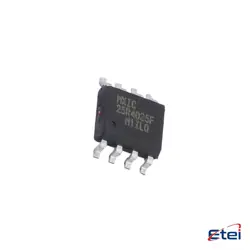
Abbildungen dienen nur als Referenz
AD7921ARMZ
+StücklisteIC ADC 12BIT SAR 8MSOP
-
HerstellerAnalog Devices Inc.
-
Herstellerteil #AD7921ARMZ
-
Datenblatt AD7921ARMZ DataSheet
-
Auf Lager8265
365 Tage Qualitätsgarantie
7*24 Stunden-Servicegarantie
90-Tage Kundendienstgarantie
Originalproduktgarantie
Spezifikationen
| Attribut | Wert |
| Part Status | Active |
| Number of Bits | 12 |
| Sampling Rate (Per Second) | 250k |
| Number of Inputs | 2 |
| Input Type | Single Ended |
| Data Interface | SPI, DSP |
| Configuration | MUX-S/H-ADC |
| Ratio - S / H: ADC | 1:1 |
| Number of A / D Converters | 1 |
| Architecture | SAR |
| Reference Type | Supply |
| Voltage - Supply, Analog | 2.35V ~ 5.25V |
| Voltage - Supply, Digital | 2.35V ~ 5.25V |
| Operating Temperature | -40°C ~ 85°C |
| Package / Case | 8-TSSOP, 8-MSOP (0.118", 3.00mm Width) |
| Supplier Device Package | 8-MSOP |
| Mounting Type | Surface Mount |
| Base Product Number | AD7921 |
Übersicht
Description
Key features include low power consumption, a built-in reference voltage, and an internal track-and-hold circuit, which stabilizes the input signal before conversion. The AD7921 is ideal for industrial automation, medical devices, and portable instrumentation due to its compact package and robust performance. Its ability to simultaneously sample multiple input channels makes it versatile for multi-sensor applications. Overall, the AD7921ARMZ is a reliable choice for engineers seeking efficient and accurate digital signal processing solutions.
Equivalent
Features
1. Resolution: 12-bit conversion for precise measurement.
2. Sampling Rate: Up to 1 MSPS (mega samples per second) for fast data acquisition.
3. Input Voltage Range: 0 to VREF, where VREF can be set externally or internally.
4. Interface: SPI-compatible serial interface for easy connectivity with microcontrollers and DSPs.
5. Low Power Consumption: Typically consumes 250 µA during operation and less than 1 µA in sleep mode, making it suitable for battery-powered applications.
6. Single Supply Operation: Operates from a single supply voltage, typically 2.7V to 5.25V.
7. Internal Reference: Includes an internal reference voltage option for simplified design.
8. Low Noise: Designed for applications requiring low noise and high accuracy.
9. Power-Down Mode: Allows for power-saving features when the ADC is not in use.
These features make the AD7921ARMZ ideal for various applications, including industrial automation, medical devices, and instrumentation.
Pinout
The primary functions of its pins are as follows:
1. VDD - Power supply for the ADC.
2. AGND - Analog ground.
3. DGND - Digital ground.
4. VREF - Reference voltage input.
5. VIN+ - Positive input for the analog signal to be converted.
6. VIN- - Negative input for the analog signal.
7. SCLK - Serial clock input for synchronous communication.
8. SDI - Serial data input.
9. SDO - Serial data output.
10. CS - Chip select input; active low to initiate communication.
11. RESET - Asynchronous reset pin.
12. MUX - Multiplexer control pin (for selecting input channels in multi-channel setups).
13. NC (Not Connected) - Not internally connected; can be left floating.
14. Other NC pins - May vary in function based on specific configurations.
This configuration allows the AD7921 to effectively convert analog signals to digital format for various applications.
Manufacturer
Analog Devices serves various industries, including telecommunications, automotive, healthcare, aerospace, and industrial automation. Their products are widely used for applications requiring precise signal processing and measurement, such as data acquisition systems, instrumentation, and control systems. The AD7921ARMZ itself is a 12-bit analog-to-digital converter (ADC) that offers high-speed performance and low power consumption, making it suitable for a range of applications in embedded systems and portable devices.
Application
1. Industrial Automation: For monitoring sensors and process control.
2. Data Acquisition Systems: Converting analog signals to digital for analysis.
3. Medical Devices: In instrumentation for patient monitoring and diagnostics.
4. Automotive Systems: For sensing and control applications.
5. Consumer Electronics: Audio and video processing.
6. Communications: Signal conditioning and processing in telecommunication devices.
Its low power consumption and high performance make it suitable for battery-operated devices and portable applications.