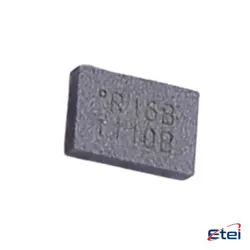
Abbildungen dienen nur als Referenz
AD823AR
+StücklisteIC OPAMP JFET 2 CIRCUIT 8SOIC
-
HerstellerAnalog Devices Inc.
-
Herstellerteil #AD823AR
-
Paket SOIC-8
-
Auf Lager3906
365 Tage Qualitätsgarantie
7*24 Stunden-Servicegarantie
90-Tage Kundendienstgarantie
Originalproduktgarantie
Spezifikationen
| Attribut | Wert |
| Package | Tube,Tube |
| ProductStatus | Obsolete |
| AmplifierType | J-FET |
| NumberofCircuits | 2 |
| OutputType | Rail-to-Rail |
| SlewRate | 25V/µs |
| -3dbBandwidth | 16 MHz |
| Current-InputBias | 5 pA |
| Voltage-InputOffset | 700 µV |
| Current-Supply | 7mA |
| Current-Output/Channel | 17 mA |
| Voltage-SupplySpan(Min) | 3 V |
| Voltage-SupplySpan(Max) | 36 V |
| OperatingTemperature | -40°C ~ 85°C |
| MountingType | Surface Mount |
| Package/Case | 8-SOIC (0.154, 3.90mm Width) |
Übersicht
Description
One of the key advantages of the AD823AR is its ability to amplify small differential voltages in the presence of large common-mode voltages, which is crucial in applications like biomedical signal processing and industrial sensor interfacing. It offers a high common-mode rejection ratio (CMRR), minimizing the impact of noise and interference.
The AD823AR is housed in a small, 8-pin SOIC package, making it suitable for space-constrained designs. It also features a simple gain configuration, adjustable by external resistors, providing design flexibility. Overall, the AD823AR is an excellent choice for engineers looking for a robust and precise instrumentation amplifier for signal conditioning tasks.
Equivalent
1. INA128 from Texas Instruments
2. MAX4466 from Maxim Integrated
3. MCP6N11 from Microchip Technology
4. LT1167 from Analog Devices (formerly Linear Technology)
5. AD620 from Analog Devices
These alternatives may vary slightly in specifications such as bandwidth, noise, and power consumption, so it's essential to verify compatibility with your specific application needs.
Features
1. Wide Supply Range: It operates on single (+3V to +36V) or dual (±1.5V to ±18V) power supplies.
2. High CMRR: The device offers a high common-mode rejection ratio (CMRR) of 86 dB, ensuring accuracy in noisy environments.
3. Low Input Bias Current: It features low input bias current, typically 1 nA, which minimizes errors due to input current.
4. Gain Configurability: The gain can be easily configured using external resistors, allowing flexibility in design.
5. Low Offset Voltage: With an input offset voltage of 800 μV, it ensures precise signal amplification.
6. Bandwidth: The AD823AR provides a bandwidth of 2 MHz, supporting a wide range of frequency applications.
7. Low Power Consumption: It consumes minimal power, making it suitable for battery-operated devices.
8. Temperature Range: It operates over a wide temperature range from -40°C to +85°C.
9. Package Options: Available in an 8-lead SOIC package, facilitating easy integration into circuits.
These features make the AD823AR ideal for medical instrumentation, industrial process controls, and portable devices.
Pinout
1. Pin 1 (REF): Reference Input. Allows for level shifting of the output voltage.
2. Pin 2 (−IN): Negative Input. Connects to the negative side of the differential signal.
3. Pin 3 (+IN): Positive Input. Connects to the positive side of the differential signal.
4. Pin 4 (−VS): Negative Power Supply. Provides the negative supply voltage.
5. Pin 5 (RG): Gain Resistor. Used to set the gain of the amplifier externally.
6. Pin 6 (OUTPUT): Output Voltage. Delivers the amplified differential signal.
7. Pin 7 (+VS): Positive Power Supply. Provides the positive supply voltage.
8. Pin 8 (NC): No Connection. Not internally connected, allows for mechanical stability.
The AD823AR is optimized for precision, low power consumption, and high performance, making it suitable for applications like medical instrumentation and data acquisition systems.
Manufacturer
Application
1. Electrocardiogram (ECG) Systems: Used in portable and wearable heart monitoring devices due to its low power and small size.
2. Patient Monitoring: Suitable for use in devices that continuously monitor physiological signals.
3. Fitness and Health Tracking: Integrated into consumer fitness devices to measure heart rate and other vital statistics.
4. Biomedical Instrumentation: Used in various medical instruments requiring accurate biopotential measurements.
5. Research and Development: Utilized in laboratory settings for physiological research and prototyping of new medical technologies.