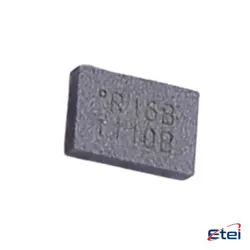
Abbildungen dienen nur als Referenz
AD8251ARMZ-R7
+StücklisteIC INST AMP 1 CIRCUIT 10MSOP
-
HerstellerAnalog Devices Inc.
-
Herstellerteil #AD8251ARMZ-R7
-
Paket MSOP-10
-
Auf Lager7644
365 Tage Qualitätsgarantie
7*24 Stunden-Servicegarantie
90-Tage Kundendienstgarantie
Originalproduktgarantie
Spezifikationen
| Attribut | Wert |
| Package / Case | Tape & Reel (TR),Cut Tape (CT) |
| Series | iCMOS® |
| Part Status | Active |
| Amplifier Type | Instrumentation |
| Number of Circuits | 1 |
| Slew Rate | 30V/µs |
| -3 dB Bandwidth | 10 MHz |
| Current - Input Bias | 5 nA |
| Voltage - Input Offset | 70 µV |
| Supply Current | 4.1mA |
| Current - Output / Channel | 37 mA |
| Voltage - Supply Span(Min) | 10 V |
| Voltage - Supply Span(Max) | 30 V |
| Operating Temperature | -40°C ~ 85°C |
| Mounting Type | Surface Mount |
Übersicht
Description
With a low offset voltage and low noise characteristics, the AD8251ARMZ-R7 ensures accurate signal amplification, essential for precision measurements in industrial and medical instrumentation. The model also boasts a high bandwidth of 10 MHz and a fast slew rate, which enables it to handle rapid signal changes effectively.
It is housed in a compact MSOP package, facilitating integration into tight spaces on PCBs. The AD8251ARMZ-R7 is ideal for applications such as data acquisition systems, process controls, and sensor interfacing, where reliable and precise amplification is critical. Its robust design and performance capabilities make it a popular choice among engineers and designers.
Equivalent
1. INA128 from Texas Instruments.
2. MAX4194 from Maxim Integrated.
3. LT1167 from Analog Devices.
4. AD620 from Analog Devices.
These alternatives offer similar functionalities, such as amplification of low-level differential signals with high input impedance, though specific performance characteristics (such as bandwidth, noise, and gain) should be compared based on your application needs.
Features
1. Gain Setting: It provides programmable gain settings of 1, 10, 100, and 1000, adjustable via a digital interface, which offers flexibility in amplification tasks.
2. High Accuracy: The amplifier boasts low offset voltage, low noise, and high common-mode rejection ratio (CMRR), ensuring precision in signal measurement.
3. Bandwidth: It offers a wide bandwidth of up to 10 MHz at a gain of 1, enabling high-speed signal processing.
4. Low Power Consumption: The device operates efficiently with a low quiescent current of approximately 4.5 mA, making it suitable for power-sensitive applications.
5. Supply Voltage: It supports dual power supply operation between ±2.3 V and ±18 V, providing versatility in different circuit designs.
6. Temperature Range: The AD8251ARMZ-R7 operates over an extended temperature range from -40°C to +85°C, ideal for industrial environments.
These features make the AD8251ARMZ-R7 a versatile component for applications requiring precision, such as medical instrumentation, data acquisition systems, and industrial process controls.
Pinout
1. +IN: Non-inverting input.
2. -IN: Inverting input.
3. RG1: Gain resistor pin 1.
4. RG2: Gain resistor pin 2.
5. +VS: Positive power supply.
6. OUT: Output.
7. -VS: Negative power supply or ground.
8. REF: Reference voltage input.
This amplifier is known for its programmable gain, allowing gains of 1, 10, 100, and 1000 through digital logic inputs. It's particularly useful for applications requiring precise signal amplification with low distortion and noise. The AD8251 is designed for ease of use in signal conditioning for data acquisition systems.
Manufacturer
Application
1. Medical Devices: Utilized in patient monitoring systems and diagnostic equipment for its precision and low noise.
2. Industrial Automation: Applied in sensor signal conditioning for process control systems.
3. Test and Measurement: Ideal for laboratory instruments requiring high accuracy and stability.
4. Data Acquisition Systems: Used to amplify small differential signals for processing and analysis.
5. Communications Equipment: Enhances signal integrity in RF and analog systems.
These applications benefit from its high bandwidth, low distortion, and programmable gain features.