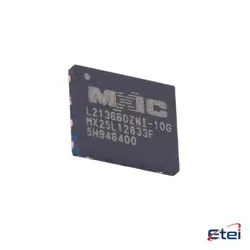
Abbildungen dienen nur als Referenz
ADS1294IPAGR
+StücklisteIC AFE 4 CHAN 24BIT 64TQFP
-
HerstellerTexas Instruments
-
Herstellerteil #ADS1294IPAGR
-
Paket TQFP-64
-
Auf Lager4357
365 Tage Qualitätsgarantie
7*24 Stunden-Servicegarantie
90-Tage Kundendienstgarantie
Originalproduktgarantie
Spezifikationen
| Attribut | Wert |
| Package | Tape & Reel (TR) |
| ProductStatus | Active |
| NumberofBits | 24 |
| NumberofChannels | 4 |
| Power(Watts) | 10.1 mW |
| Voltage-SupplyAnalog | 2.7V ~ 5.5V |
| Voltage-SupplyDigital | 1.65V ~ 3.6V |
| MountingType | Surface Mount |
| Package/Case | 64-TQFP |
Übersicht
Description
It operates on a single power supply with a power-saving mode, making it suitable for portable and battery-powered medical devices. The ADS1294IPAGR includes built-in amplifiers, voltage references, and a lead-off detection circuit, which simplifies the design process and reduces the need for additional external components. Additionally, it offers programmable data rates, input signal channels, and an SPI interface for easy integration into digital systems.
Overall, the ADS1294IPAGR provides a compact, efficient, and cost-effective solution for developers looking to implement reliable biopotential measurement systems in the medical field.
Equivalent
1. ADAS1000 from Analog Devices, offering similar multi-channel ECG front-end functionality.
2. MCP3913 from Microchip, a 24-bit, 6-channel analog front-end with similar performance.
3. MAX30003 from Maxim Integrated, a single-channel but high-precision ECG front-end.
These alternatives provide comparable performance in medical and biopotential measurement applications. Always verify specific requirements like channel count and power consumption before selecting.
Features
1. High Resolution: Offers 24-bit resolution for precise analog signal conversion.
2. Low Noise: Provides low noise performance, crucial for accurate biopotential readings.
3. Low Power: Designed for power efficiency, making it ideal for portable and battery-powered devices.
4. Data Rate: Supports various data rates up to 32 kSPS per channel, allowing flexibility in signal processing.
5. Integrated Programmable Gain Amplifiers (PGAs): Features built-in PGAs for signal amplification with selectable gains.
6. Flexible Input Multiplexer: Allows for different channel configurations and input selections.
7. Integrated Reference: Includes an integrated reference for stable and consistent measurements.
8. Lead-Off Detection: Offers functionality to detect electrode disconnection, ensuring signal reliability.
9. Serial Interface: Incorporates an SPI-compatible interface for communication with microcontrollers or processors.
10. Compact Package: Available in a small TQFP package, suitable for space-constrained applications.
These features make the ADS1294IPAGR ideal for medical and scientific applications requiring precise and reliable signal acquisition.
Pinout
The ADS1294IPAGR provides several key functions:
1. Multi-channel Input: It can process four differential input channels, making it suitable for simultaneous multi-lead signal acquisition.
2. High Resolution: Offers 24-bit resolution to ensure precise and accurate readings of biopotential signals.
3. Programmable Gain Amplifier (PGA): Each channel includes a PGA to handle a wide range of input signal amplitudes.
4. Flexible Data Rates: Supports multiple data rates, allowing users to balance between power consumption and signal quality.
5. Integrated Features: Includes a built-in oscillator, internal reference, data-ready indicator, and lead-off detection to facilitate ECG/EEG applications.
6. Low Power Consumption: Designed for low power operation to enhance battery life in portable devices.
These features make ADS1294IPAGR ideal for designing compact, efficient, and accurate biopotential measurement systems.
Manufacturer
Application
1. Medical Devices: Used in electrocardiograms (ECGs) and patient monitoring systems to measure electrical activity of the heart.
2. Wearable Health Devices: Incorporated in fitness trackers and smartwatches for heart rate monitoring.
3. Research and Development: Employed in biomedical research for acquiring high-fidelity bio-signals.
4. Electrophysiology: Useful in neural recording and other electrophysiological measurements.
5. Portable Diagnostics: Facilitates the design of portable and battery-operated diagnostic equipment.
Its low power consumption and high precision make it suitable for both portable and stationary medical applications.