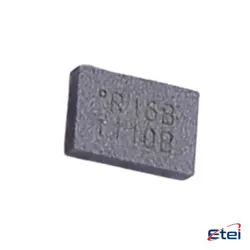
Abbildungen dienen nur als Referenz
AS3933-BTST
+StücklisteIC RFID READER 15-150KHZ 16TSSOP
-
HerstellerScioSense
-
Herstellerteil #AS3933-BTST
-
Paket TSSOP-16
-
Auf Lager4760
365 Tage Qualitätsgarantie
7*24 Stunden-Servicegarantie
90-Tage Kundendienstgarantie
Originalproduktgarantie
Spezifikationen
| Attribut | Wert |
| Package / Case | Tape & Reel (TR),Cut Tape (CT) |
| Part Status | Active |
| Type | RFID Reader |
| Frequency | 15kHz ~ 150kHz |
| Voltage - Supply | 2.4V ~ 3.6V |
| Operating Temperature | -40°C ~ 85°C |
| Mounting Type | Surface Mount |
Übersicht
Description
Key features of the AS3933-BTST include:
1. Multi-Channel Operation: It supports the detection of signals across three channels, enhancing its versatility and robustness in signal recognition.
2. Low Power Consumption: The device is optimized for minimal energy use, making it suitable for applications that require long battery life.
3. Adjustable Sensitivity: Users can configure the device's sensitivity to suit specific application needs, allowing for flexible deployment in various environments.
4. Frequency Range: It typically operates within a frequency range of 15-150 kHz, suitable for a range of low-frequency applications.
5. Wake-up Functionality: It enables systems to remain in a low-power sleep mode until a specific signal pattern is detected, thus conserving energy.
The AS3933-BTST is commonly used in remote sensors, smart meters, and security systems, among other applications.
Equivalent
1. NXP's Kinetis series MCUs with low-power wake-up capabilities.
2. Texas Instruments' CC1101, a low-power RF transceiver.
3. Microchip's ATA5830 series, a low-power RF transceiver.
4. Silicon Labs’ Si4355, a low-power RF receiver.
Each product has unique features, so it’s important to verify compatibility with your specific application requirements.
Features
1. Three-Channel Wake-Up: It can simultaneously monitor three frequency channels, enhancing reliability and reducing false wake-ups.
2. Low Power Consumption: The chip is designed for battery-operated devices, with minimal power usage during idle and active states.
3. Adjustable Sensitivity: Users can adjust sensitivity settings to balance between range and power consumption.
4. Data Demodulation: Capable of demodulating amplitude-shift keying (ASK) and frequency-shift keying (FSK) signals, allowing for flexibility in communication protocols.
5. Programmable Features: Includes programmable wake-up patterns and thresholds to suit various applications.
6. Automatic Antenna Tuning: Ensures optimal performance across different environmental conditions and antenna designs.
7. Digital RSSI: Provides a digital output for Received Signal Strength Indication, aiding in signal analysis and diagnostics.
8. UART Interface: Facilitates easy integration with microcontrollers and other digital systems.
These features make the AS3933-BTST suitable for applications like remote keyless entry, alarm systems, and other devices requiring efficient wake-up communication.
Pinout
1. VDD: Supply voltage pin.
2. GND: Ground connection.
3. LF1, LF2, LF3: Low-frequency inputs for the antenna connections.
4. RESN: External reset pin, active low.
5. SDO: Serial Data Output for SPI communication.
6. SDI: Serial Data Input for SPI communication.
7. SCLK: Serial Clock for SPI communication.
8. CSN: Chip Select for SPI, active low.
9. IRQ: Interrupt request output, signals when a wake-up event occurs.
10. CL_DAT: Clock/Data pin for Manchester mode.
11. CL_DAT_EN: Enable input for Manchester clock/data mode.
12. VSS: Ground reference pin (often connected to GND internally).
13. TR_SEL: Selects the wake-up pattern.
14. TR_D: Data input pin for pattern/training purposes.
15. NC: No connection or reserved for future use.
16. NC: No connection or reserved for future use.
These pins collectively enable the AS3933-BTST to function as a versatile wake-up receiver, suitable for low-power applications.