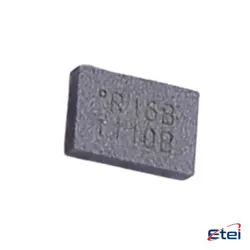
Abbildungen dienen nur als Referenz
AT24C16C-PUM
+StücklisteIC EEPROM 16KBIT I2C 1MHZ 8DIP
-
HerstellerMikrochip-Technologie
-
Herstellerteil #AT24C16C-PUM
-
Datenblatt AT24C16C-PUM DataSheet
-
Paket 8-DIP
-
Auf Lager4245
365 Tage Qualitätsgarantie
7*24 Stunden-Servicegarantie
90-Tage Kundendienstgarantie
Originalproduktgarantie
Spezifikationen
| Attribut | Wert |
| Package | Tube |
| ProductStatus | Active |
| MemoryType | Non-Volatile |
| MemoryFormat | EEPROM |
| Technology | EEPROM |
| MemorySize | 16Kb (2K x 8) |
| MemoryInterface | I²C |
| ClockFrequency | 1 MHz |
| WriteCycleTime-WordPage | 5ms |
| AccessTime | 550 ns |
| Voltage-Supply | 1.7V ~ 5.5V |
| OperatingTemperature | -40°C ~ 85°C (TA) |
| MountingType | Through Hole |
| Package/Case | 8-DIP (0.300, 7.62mm) |
Übersicht
Description
Key features include a wide operating voltage range from 1.7V to 5.5V, low power consumption, and a maximum clock frequency of 1 MHz. The device offers byte-level and page-level write capabilities, with up to 16 bytes per page. Its data retention is up to 100 years, with a write endurance of 1 million cycles per byte, ensuring durability and longevity.
The AT24C16C-PUM is commonly used in applications requiring data storage, such as consumer electronics, industrial systems, and automotive applications. Packaged in a small 8-lead PDIP, SOIC, TSSOP, or UDFN, it offers flexibility in design and space-saving advantages. Its ease of use and robust performance make it a popular choice for embedded systems.
Equivalent
1. Microchip AT24C16D - Another variant from the same manufacturer.
2. STMicroelectronics M24C16 - Offers similar functionality.
3. ON Semiconductor CAT24C16 - A comparable alternative.
4. Rohm BR24C16 - Provides similar storage and I2C compatibility.
5. NXP Semiconductors PCA24S16 - Offers equivalent features.
These chips provide similar storage capacities and I2C interfacing capabilities.
Features
1. Memory Organization: It has 2048 x 8-bit memory cells.
2. Interface: Utilizes an I2C serial interface, supporting fast-mode speeds up to 1 MHz.
3. Voltage Range: Operates across a wide voltage range from 1.7V to 5.5V.
4. Endurance: High endurance with 1 million write cycles and data retention of over 100 years.
5. Page Write: Supports page write capability of up to 16 bytes.
6. Write Protection: Incorporates a write-protect feature for the entire array.
7. Low Power Consumption: Features low standby and active currents.
8. Pin Count: Available in an 8-lead PDIP, SOIC, and TSSOP packages.
9. Temperature Range: Operates in industrial temperature range (-40°C to +85°C).
10. Security: Includes a hardware write protection pin for secure data storage.
11. Compatibility: Fully compatible with existing 24C16 devices.
The AT24C16C-PUM is ideal for applications requiring non-volatile data storage in a compact package with reliable performance.
Pinout
1. A0, A1, A2: Device address inputs. These pins are used to select the I2C address of the device, allowing multiple EEPROMs to be used on the same I2C bus.
2. GND: Ground. This pin is connected to the system ground.
3. SDA: Serial Data. This is a bidirectional pin used to transfer data to and from the microcontroller.
4. SCL: Serial Clock. This pin is used to synchronize the communication between the microcontroller and the EEPROM.
5. WP: Write Protect. This pin can be used to enable or disable write operations to the EEPROM.
6. VCC: Power Supply. This pin is connected to the positive supply voltage.
These pins support the I2C protocol, making the AT24C16C-PUM suitable for applications requiring non-volatile storage.
Manufacturer
Application
1. Consumer Electronics: Used for storing calibration data, user preferences, and device settings.
2. Industrial Control: Stores configuration and operation parameters in control systems.
3. Automotive Systems: Retains data such as diagnostic codes and configuration settings.
4. Medical Devices: Preserves user settings and operational logs.
5. Communication Equipment: Utilized in routers and switches for configuration data.
6. Computing Devices: Used in laptops and PCs for BIOS storage and system configuration.
Its low power consumption and non-volatile storage make it ideal for applications requiring reliable data retention.