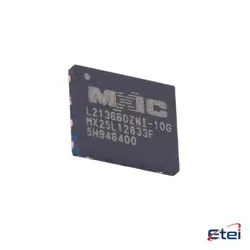
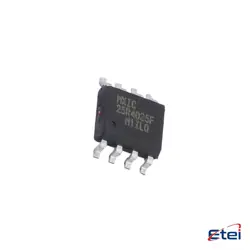
Abbildungen dienen nur als Referenz
AT45DB642D-TU
+StücklisteIC FLASH 64MBIT SPI 66MHZ 28TSOP
-
HerstellerAdesto Technologies
-
Herstellerteil #AT45DB642D-TU
-
Paket TSOP-28
-
Auf Lager6357
365 Tage Qualitätsgarantie
7*24 Stunden-Servicegarantie
90-Tage Kundendienstgarantie
Originalproduktgarantie
Spezifikationen
| Attribut | Wert |
| Package / Case | Tray |
| Part Status | Obsolete |
| Memory Type | Non-Volatile |
| Memory Format | FLASH |
| Technology | FLASH |
| Memory Size | 64Mb (1056 Bytes x 8192 pages) |
| Memory Interface | SPI |
| Clock Frequency | 66 MHz |
| Write Cycle Time - Word Page | 6ms |
| Voltage - Supply | 2.7V ~ 3.6V |
| Operating Temperature | -40°C ~ 85°C (TC) |
| Mounting Type | Surface Mount |
Übersicht
Description
Key features of the AT45DB642D-TU include a high-speed SPI (Serial Peripheral Interface) for serial communication, dual and quad input/output options for faster data transfer, and advanced protection modes for secure data storage. It also supports important functions like block erase, sector erase, and full-chip erase, contributing to versatile memory management. The device is commonly used in applications requiring data storage such as digital cameras, industrial equipment, and consumer electronics.
Housed in a compact, space-efficient 8-pin SOIC or 9mm x 9mm BGA package, the AT45DB642D-TU is designed for robust performance across a range of temperatures, ensuring reliability in various environments.
Equivalent
1. Winbond W25Q64BV - 64 Mbit Serial Flash memory.
2. Macronix MX25L6406E - 64 Mbit Serial Flash memory.
3. Micron N25Q064A - 64 Mbit Serial Flash memory.
4. SST25VF064C - 64 Mbit Serial Flash memory.
These products are similar in terms of capacity and interface type, although specific features and performance characteristics may vary. Always check datasheets for compatibility.
Features
1. Dual Interface: Supports both Serial Peripheral Interface (SPI) and advanced 8-bit RapidS serial interface.
2. Page Size: Configurable page size of 512 bytes or 528 bytes to enhance flexibility.
3. Block Architecture: Organized into 2048 pages for efficient data management.
4. Sector Erase: Allows for erasing in sectors, blocks, and pages, offering flexibility in memory management.
5. Low Power Consumption: Designed for low power usage, making it suitable for battery-operated applications.
6. Fast Read/Write: Provides fast read and write operations with a maximum clock speed of up to 66 MHz.
7. Data Protection: Features include hardware and software data protection mechanisms.
8. Endurance and Retention: High endurance with 100,000 write/erase cycles per page and data retention of up to 20 years.
9. Temperature Range: Operates in a wide temperature range from -40°C to +85°C.
These features make the AT45DB642D-TU suitable for applications requiring reliable and efficient data storage.
Pinout
1. CS (Chip Select): Activates the device when low, allowing communication.
2. SCK (Serial Clock): Provides the clock signal for the SPI bus.
3. SI (Serial Input): Used to input data and commands into the device.
4. SO (Serial Output): Outputs data from the device.
5. WP (Write Protect): Disables write operations to the status register if low.
6. RESET: Resets the device when low, clearing internal states.
7. VCC: Power supply pin for the device.
8. GND: Ground pin, the reference point for all signals.
This configuration allows the AT45DB642D-TU to operate using a standard Serial Peripheral Interface (SPI) and provides features like fast page and block erase, flexible programming options, and low-power dissipation, making it suitable for various applications requiring non-volatile storage.
Manufacturer
Application
1. Consumer Electronics: Ideal for gadgets like digital cameras, MP3 players, and personal digital assistants (PDAs) for storing firmware and user data.
2. Industrial Systems: Used in embedded systems for data logging, firmware storage, and configuration data.
3. Automotive: Suitable for infotainment systems and electronic control units (ECUs) requiring reliable data retention.
4. Networking Equipment: Utilized in routers and switches for firmware and configuration storage.
5. Medical Devices: Ensures secure storage of critical data in portable devices.
6. Telecommunications: Supports data storage in mobile and fixed line communication devices.