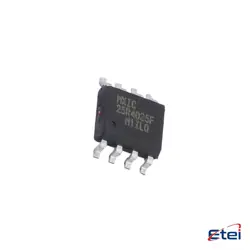
Abbildungen dienen nur als Referenz
AT88SC6416C-CI
+StücklisteIC EEPROM 64K I2C 5MHZ 8LAP
-
HerstellerMikrochip-Technologie
-
Herstellerteil #AT88SC6416C-CI
-
Paket TDFN-8
-
Auf Lager9432
365 Tage Qualitätsgarantie
7*24 Stunden-Servicegarantie
90-Tage Kundendienstgarantie
Originalproduktgarantie
Spezifikationen
| Attribut | Wert |
| Package / Case | Tube |
| Series | CryptoMemory® |
| Part Status | Obsolete |
| Type | Secure Memory |
| Applications | Embedded, Smart Card |
| Mounting Type | Surface Mount |
Übersicht
Description
Security features include encryption for data transmission to prevent unauthorized access, and a unique 64-bit identification number for each chip. Its flexible memory architecture allows for multiple user zones, each with distinct access rights, thus enabling versatile application-specific configurations. The AT88SC6416C-CI is often used in systems requiring secure data storage and access control, providing a robust solution for safeguarding information against tampering and unauthorized access.
Equivalent
1. STMicroelectronics M24LR64E-R: Offers similar EEPROM functionality with NFC/RFID features.
2. Infineon SLE 66CLX641P: Provides secure smart card solutions with similar memory capacity.
3. NXP MIFARE Ultralight C: Suitable for contactless applications with security features.
When choosing an equivalent, ensure compatibility with your specific security and communication requirements. Always verify datasheets to match the technical specifications.
Features
1. Memory Capacity: It provides 64 Kbits of EEPROM, organized into 16 user zones, allowing flexible data storage and access control.
2. Security: The device employs advanced security mechanisms, such as mutual authentication, encrypted checksums, and a proprietary encryption algorithm to ensure data integrity and confidentiality.
3. Authentication: It supports a two-way authentication protocol to validate both the host and the device, enhancing security against unauthorized access.
4. Programmable Access Rights: Each user zone can have independent access rights, defined by the user, to control read and write operations.
5. Anti-tearing Support: The device features anti-tearing safeguards that protect data from corruption during interrupted write operations, ensuring reliable data storage.
6. Communication Interface: It operates over a standard two-wire serial interface, compatible with I²C protocols, facilitating easy integration into various systems.
7. Low Power Consumption: Designed for low power applications, it is suitable for battery-operated devices.
These features make the AT88SC6416C-CI ideal for use in secure data storage, authentication, and access control applications.
Pinout
1. VCC: This is the power supply pin for the chip.
2. GND: The ground connection pin.
3. SDA (Serial Data): This pin is used for data input and output. It is part of the I2C communication interface.
4. SCL (Serial Clock): This pin serves as the clock input for the I2C interface, synchronizing data transfer.
5. RST (Reset): Used to reset the device, this pin ensures the chip returns to a known state.
6. NC (No Connect): This pin is typically unused and left unconnected.
7. RFU (Reserved for Future Use): This is another pin that is not currently used.
8. WP (Write Protect): This pin is used to enable or disable the write protection feature, safeguarding data from unauthorized writing.
The AT88SC6416C-CI is designed for secure data storage and is commonly used in authentication and encryption applications.
Manufacturer
Application
1. Access Control: Used in secure identification and authentication systems for buildings and facilities.
2. Consumer Electronics: Provides secure storage for user data and settings in devices like set-top boxes and gaming consoles.
3. E-Government: Utilized in secure ID cards and passports.
4. Medical Devices: Ensures the confidentiality and integrity of patient data.
5. Industrial Systems: Protects firmware and intellectual property in embedded systems.
6. Financial Transactions: Facilitates secure data storage for payment cards and point-of-sale systems.
These applications leverage the chip's security features, including encryption and authentication capabilities.