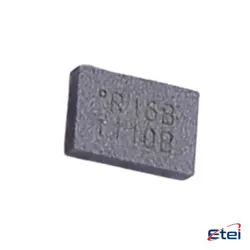
Abbildungen dienen nur als Referenz
ATTINY13-20SSU
+StücklisteIC MCU 8BIT 1KB FLASH 8SOIC
-
HerstellerMikrochip-Technologie
-
Herstellerteil #ATTINY13-20SSU
-
Datenblatt ATTINY13-20SSU DataSheet
-
Auf Lager3151
365 Tage Qualitätsgarantie
7*24 Stunden-Servicegarantie
90-Tage Kundendienstgarantie
Originalproduktgarantie
Spezifikationen
| Attribut | Wert |
| Series | AVR® ATtiny |
| Part Status | Active |
| Base Product Number | ATTINY13 |
| DigiKey Programmable | Verified |
| Core Processor | AVR |
| Core Size | 8-Bit |
| Speed | 20MHz |
| Peripherals | Brown-out Detect/Reset, POR, PWM, WDT |
| Number of I/O | 6 |
| Program Memory Size | 1KB (512 x 16) |
| Program Memory Type | FLASH |
| EEPROM Size | 64 x 8 |
| RAM Size | 64 x 8 |
| Voltage - Supply (Vcc/Vdd) | 2.7V ~ 5.5V |
| Data Converters | A/D 4x10b |
| Oscillator Type | Internal |
| Operating Temperature | -40°C ~ 85°C (TA) |
| Mounting Type | Surface Mount |
| Supplier Device Package | 8-SOIC |
| Package | 8-SOIC (0.154", 3.90mm Width) |
| Packaging | Tube |
Übersicht
Description
The microcontroller is equipped with 6 general-purpose I/O pins, making it suitable for small-scale projects. It includes a built-in 8-bit timer/counter, Watchdog Timer, and Analog Comparator. The ATTINY13-20SSU is also notable for its low-power consumption, ideal for battery-operated devices. It comes in a SOIC-8 package, which is convenient for space-constrained designs.
Programmed via In-System Programming (ISP), it supports multiple programming platforms, including Atmel Studio and Arduino IDE with the right configurations. This makes the ATTINY13-20SSU a versatile choice for hobbyists and engineers alike, particularly in applications requiring cost-effectiveness and compact design.
Equivalent
1. Microchip Technology's ATTINY13A-SSU– a slight variant with similar specifications.
2. ATTINY25-20SSU – offers more features and memory.
3. STMicroelectronics' STM8S003F3 – an 8-bit microcontroller with comparable specs.
4. NXP Semiconductors' LPC81x series – ARM Cortex-M0+ based microcontrollers with similar applications.
These alternatives provide similar functionality, though architectural differences may exist. Always verify compatibility with specific application requirements.
Features
1. 8-bit RISC Architecture: Provides a simple instruction set optimized for efficiency.
2. Performance: Operates at up to 20 MHz, offering reliable processing power for small applications.
3. Memory: Includes 1 KB of Flash memory for program storage, 64 bytes of EEPROM for data retention, and 64 bytes of SRAM for runtime data.
4. I/O Ports: Equipped with 6 I/O pins to interface with external devices.
5. Timers: Features an 8-bit timer/counter with PWM capabilities for precise timing and control tasks.
6. Analog Comparator: Allows simple analog signal processing.
7. Operating Voltage: Functions within a 2.7V to 5.5V range, suitable for battery-powered devices.
8. Low Power Consumption: Designed with multiple power-saving modes, ideal for energy-efficient applications.
9. Package: Available in an 8-pin SOIC package, compact for space-constrained environments.
This microcontroller is well-suited for applications requiring basic computation, small size, and low power usage.
Pinout
1. VCC (Pin 8): Power supply voltage.
2. GND (Pin 4): Ground.
3. PB0-PB5 (Pins 5, 6, 7, 1, 2, 3): I/O ports that can be configured as either input or output. They also serve multiple functions such as ADC inputs, PWM outputs, or other peripheral interfaces like SPI.
The ATtiny13 is a versatile microcontroller with features including a 10-bit ADC, PWM, timers, and support for external interrupts. It is designed for applications requiring low power consumption and compact size.
Manufacturer
Application
1. Consumer Electronics: Used in remote controls, toys, and simple electronic gadgets.
2. Automotive Systems: Employed for tasks such as interior lighting control and sensor interfacing.
3. Home Automation: Suitable for smart switches, sensors, and small-scale control systems.
4. Industrial Automation: Utilized in simple motor controls and sensor data processing.
5. Wearable Devices: Ideal for low-power, small-size wearable technology.
6. LED Lighting: Used in dimmers and basic lighting control applications.
Its low power consumption and cost-effectiveness make it a versatile choice for various compact, low-complexity applications.