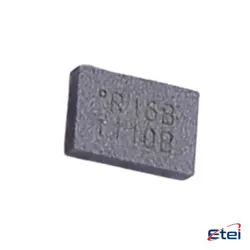
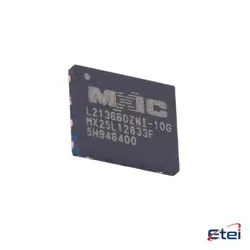
Abbildungen dienen nur als Referenz
ATTINY861-15MZ
+StücklisteIC MCU 8BIT 8KB FLASH 32QFN
-
HerstellerMikrochip-Technologie
-
Herstellerteil #ATTINY861-15MZ
-
Datenblatt ATTINY861-15MZ DataSheet
-
Auf Lager8330
365 Tage Qualitätsgarantie
7*24 Stunden-Servicegarantie
90-Tage Kundendienstgarantie
Originalproduktgarantie
Spezifikationen
| Attribut | Wert |
| Series | AVR® ATtiny |
| PartStatus | Active |
| DigiKeyProgrammable | Not Verified |
| CoreProcessor | AVR |
| CoreSize | 8-Bit |
| Speed | 16MHz |
| Connectivity | USI |
| Peripherals | Brown-out Detect/Reset, POR, PWM, WDT |
| NumberofI/O | 16 |
| ProgramMemorySize | 8KB (4K x 16) |
| ProgramMemoryType | FLASH |
| EEPROMSize | 512 x 8 |
| RAMSize | 512 x 8 |
| Voltage-Supply(Vcc/Vdd) | 2.7V ~ 5.5V |
| DataConverters | A/D 11x10b |
| OscillatorType | Internal |
| OperatingTemperature | -40°C ~ 125°C (TA) |
| MountingType | Surface Mount |
| SupplierDevicePackage | 32-QFN (5x5) |
| Package/Case | 32-VFQFN Exposed Pad |
| BaseProductNumber | ATTINY861 |
| Grade | Automotive |
| Qualification | AEC-Q100 |
Übersicht
Description
With 32 programmable I/O pins, it supports multiple interfacing options including SPI, USART, and I2C, enhancing its versatility for projects in automation, robotics, and sensor-based systems. The microcontroller also includes a 10-bit ADC and several timers/counters, enabling precise control and measurement functionalities.
Operating on a voltage range of 1.8V to 5.5V, the ATTINY861 is ideal for battery-powered applications. It can be programmed using the popular AVR-GCC toolchain, making it accessible for hobbyists and professionals alike. The device is available in various packages, including a 32-pin TQFP, allowing for easy integration into different circuit designs. Overall, the ATTINY861-15MZ offers a balance of performance, flexibility, and power efficiency suitable for diverse embedded applications.
Equivalent
Features
- Memory: 8 KB of flash memory, 512 bytes of SRAM, and 256 bytes of EEPROM.
- Clock Speed: Operates at a maximum frequency of 15 MHz.
- I/O Ports: 12 general-purpose I/O pins.
- Timers: Three 8-bit timers and one 16-bit timer for various timing applications.
- ADC: 10-bit Analog-to-Digital Converter with up to 8 input channels.
- PWM: Up to 4 channels of pulse width modulation.
- Communication: Supports USART, SPI, and I2C for various serial communications.
- Operating Voltage: Can operate between 2.7V to 5.5V.
- Power Consumption: Low power consumption, suitable for battery-operated devices.
The ATtiny861 is ideal for compact and energy-efficient embedded applications, such as consumer electronics, automotive, and industrial control systems.
Pinout
- Digital I/O: 12 general-purpose I/O pins, configurable for input or output.
- Analog functionality: Includes an Analog Comparator and a 10-bit ADC (Analog-to-Digital Converter) with up to 8 channels.
- Timer/Counters: 2 Timer/Counter units (one 8-bit and one 16-bit) for various timing applications.
- Communication Interfaces: Supports USART for serial communication and SPI for connecting to other components.
- Reset and Clocking: Includes a reset pin and supports various clock sources, including an internal oscillator.
The device operates at a maximum clock frequency of 15 MHz and is suitable for low-power applications, making it ideal for embedded systems.
Manufacturer
Microchip is known for its innovative microcontroller solutions, including the AVR and PIC families, which are widely used in various electronic projects and product designs. The ATTINY861 is part of the AVR microcontroller series and is particularly favored for its low power consumption and ease of use, making it suitable for both hobbyist projects and professional applications. Microchip also provides extensive development tools, software, and support to assist engineers and developers in their design processes, solidifying its position as a key player in the semiconductor industry.
Application
1. Embedded Systems: Ideal for small, low-power devices.
2. Consumer Electronics: Used in remote controls, toys, and home appliances.
3. Automotive: Implemented in vehicle monitoring systems and control modules.
4. Industrial Automation: Suitable for sensors, actuators, and control systems.
5. Wearable Technology: Powers fitness trackers and health monitoring devices.
6. IoT Devices: Supports smart home applications and connected sensors.
7. Prototyping: Used in development boards and for educational projects.
Its low power consumption and versatile I/O capabilities make it a popular choice across these domains.