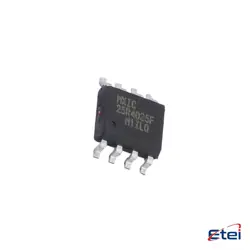
Abbildungen dienen nur als Referenz
BQ25570RGRR
+StücklisteIC ENERGY HARV CTRLR BATT 20VQFN
-
HerstellerTexas Instruments
-
Herstellerteil #BQ25570RGRR
-
Paket VQFN (RGR)-20
-
Auf Lager6719
365 Tage Qualitätsgarantie
7*24 Stunden-Servicegarantie
90-Tage Kundendienstgarantie
Originalproduktgarantie
Spezifikationen
| Attribut | Wert |
| Package | Tape & Reel (TR),Cut Tape (CT) |
| ProductStatus | Active |
| Applications | Energy Harvesting |
| Current-Supply | 488nA |
| Voltage-Supply | 0.12V ~ 4V |
| OperatingTemperature | -40°C ~ 125°C |
| MountingType | Surface Mount |
| Package/Case | 20-VFQFN Exposed Pad |
Übersicht
Description
Key features of the BQ25570RGRR include:
1. Energy Harvesting: It efficiently captures and manages microwatts to milliwatts of power from ambient sources, maximizing energy extraction with its high-efficiency boost converter.
2. Battery Management: It supports battery charging, providing regulated output to power microcontrollers or other low-power devices and managing battery health with its integrated battery management circuit.
3. Low Start-Up Voltage: The device can start harvesting energy at input voltages as low as 330 mV, making it suitable for low-voltage energy sources.
4. Regulated Output: It provides a regulated output voltage to ensure stable power delivery to connected devices.
Overall, the BQ25570RGRR is an ideal solution for extending the battery life and efficiency of low-power applications by harnessing ambient energy sources.
Equivalent
1. Linear Technology LTC3105 - A highly efficient DC/DC converter for energy harvesting applications.
2. Analog Devices ADP5090 - A boost regulator for energy harvesting with low quiescent current.
3. Cypress S6AE102A - An energy harvesting PMIC suitable for low-power applications.
4. Maxim Integrated MAX17710 - A PMIC designed for harvesting energy from weak sources.
Please check specific datasheets for detailed feature comparisons and compatibility.
Features
1. Energy Harvesting: Supports ultra-low voltage start-up from 330 mV and operates with input voltages ranging from 100 mV to 5.5 V, making it ideal for solar cells, thermoelectric generators, or other low-voltage sources.
2. Power Management: Integrates a DC-DC boost converter to charge batteries or capacitors, while a buck converter provides a regulated voltage output from 1.8 V to 5.5 V, suitable for powering microcontrollers and sensors.
3. Efficiency: Achieves high efficiency with low quiescent current consumption, maximizing energy utilization from the harvester source.
4. Battery Management: Features battery management functionality including overvoltage protection, battery undervoltage protection, and a battery discharge function.
5. Programmability: Offers programmable settings for maximum power point tracking (MPPT) to optimize energy harvesting under varying environmental conditions.
6. Compact Package: Comes in a small 2 mm x 3 mm VQFN package, suitable for space-constrained designs.
These features make the BQ25570RGRR ideal for applications like wireless sensor nodes, wearable devices, and other IoT applications requiring efficient energy harvesting and management.
Pinout
1. VIN_DC: Input for the DC voltage source.
2. VSS: Ground reference for the IC.
3. VBAT: Output for the battery connection.
4. VB_SEC: Secondary battery output.
5. VBAT_OK: Indicates the battery voltage level status.
6. VOUT_EN: Enables the output regulation.
7. VOUT: Regulated output voltage.
8. VLBOOST: Output of the internal boost converter.
9. EN: Enable pin for the IC.
10. MPPT: Maximum Power Point Tracking input.
11. VOC_SAMP: Sampling pin for open-circuit voltage.
12. PGOOD: Power good indicator.
13. OK_PROG: Configures the battery OK threshold.
14. REF: Reference voltage output.
15. RSET: Sets the voltage on the REF pin.
16. CE: Charge enable pin.
These pins facilitate various functions such as energy harvesting, battery management, and power regulation, optimized for ultra-low power applications.
Manufacturer
Application
1. IoT Devices: Providing power to sensors and wireless communication modules in energy-constrained environments.
2. Wearable Electronics: Supplying energy to fitness trackers and health monitoring devices.
3. Remote Monitoring Systems: Enabling long-term operation of remote environmental or industrial sensors.
4. Energy Harvesting Systems: Efficiently extracting energy from solar, thermal, or vibrational sources.
5. Backup Power Supplies: Maintaining power for critical system elements during outages.
These areas leverage the IC’s ability to maximize energy extraction and manage low-voltage, low-power inputs efficiently.