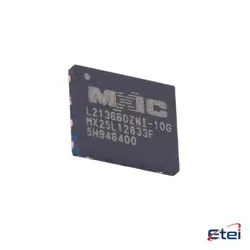
Abbildungen dienen nur als Referenz
EPCQ128ASI16N
+StücklisteIC CONFIG DEVICE 128MBIT 16SOIC
-
HerstellerIntel
-
Herstellerteil #EPCQ128ASI16N
-
Paket SOIC-16
-
Auf Lager7383
365 Tage Qualitätsgarantie
7*24 Stunden-Servicegarantie
90-Tage Kundendienstgarantie
Originalproduktgarantie
Spezifikationen
| Attribut | Wert |
| Package / Case | Tube |
| Series | EPCQ-A |
| Part Status | Active |
| Programmable Type | In System Programmable |
| Memory Size | 128Mb |
| Voltage - Supply | 2.7V ~ 3.6V |
| Operating Temperature | -40°C ~ 85°C |
| Mounting Type | Surface Mount |
Übersicht
Description
The "ASI16N" part of the name indicates specific packaging and interface details. It is housed in a compact 16-pin small outline integrated circuit (SOIC) package, which is suitable for surface-mount technology (SMT) applications. The device supports a standard serial peripheral interface (SPI), enabling efficient communication with the FPGA.
Notably, the EPCQ128ASI16N provides high-reliability memory storage with fast read and write capabilities, which are crucial for reducing FPGA configuration time. It also offers features like sector protection and secure device configuration, enhancing both the reliability and security of the configuration process.
Equivalent
1. EPCQ128 in different packages or temperature grades.
2. Micron N25Q128A series, a 128Mb serial NOR Flash.
3. Winbond W25Q128FV series, another 128Mb serial Flash memory.
4. Macronix MX25L128 series.
These alternatives offer similar storage capacities and interfaces but ensure compatibility with your specific application requirements.
Features
The EPCQ128ASI16N is designed to provide a reliable and efficient configuration for FPGAs, with a high data transfer rate that accelerates configuration times. It has a compact form factor, available in a 16-pin SOIC package, which is suitable for space-constrained applications. The device supports advanced security features, such as memory protection and read-back protection, ensuring the safety of the stored configuration data.
The EPCQ128ASI16N is ideal for applications needing frequent updates or changes to FPGA configurations, and it integrates seamlessly into designs requiring non-volatile memory solutions.
Pinout
1. Data Input (DATA): Used for serial data input.
2. Data Output (DOUT): Provides serial data output.
3. Clock (CLK): Serial data is synchronized with this clock signal.
4. Chip Select (nCS): Enables the device when driven low.
5. Write Protection (WP#): Used to protect certain parts of the memory from being overwritten.
6. Hold (HOLD#): Pauses the serial communication without losing data.
7. VCC: Power supply pin.
8. GND: Ground pin.
The remaining pins can be used for various other purposes as needed in specific configurations, but the above functions are the primary ones associated with the operation of the EPCQ128ASI16N. This device is typically used to load configuration data into FPGA devices.
Manufacturer
Intel's business operations cover a wide range of products and services beyond semiconductors, including microprocessors, integrated graphics chips, and various other forms of computer hardware and software. The company is renowned for its innovation in the field of computing technology and for being a driving force in the development of the personal computer (PC) industry.
In 2015, Intel acquired Altera, which specialized in programmable logic devices like FPGAs (Field-Programmable Gate Arrays). The EPCQ128ASI16N is a serial configuration device often used in conjunction with FPGAs, which aligns with the type of products that Altera was known for before its acquisition. Intel continues to expand its portfolio in areas such as artificial intelligence, cloud computing, and Internet of Things (IoT) technologies, maintaining its status as a leader in the tech industry.
Application
1. FPGA Configuration: Stores bitstreams for configuration and reconfiguration of FPGAs.
2. Embedded Systems: Used in systems requiring reliable, non-volatile memory for boot-up processes.
3. Industrial Automation: Supports systems needing robust and durable memory solutions.
4. Telecommunications: Utilized in networking equipment requiring reliable configuration data storage.
5. Consumer Electronics: Employed in devices needing secure storage for firmware updates or configuration data.
These applications leverage its features like high-density storage and serial interface for efficient data management.