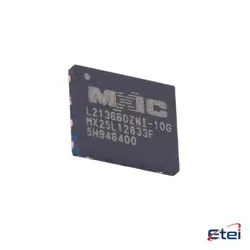
Abbildungen dienen nur als Referenz
EPM7128SQC100-15
+StücklisteIC CPLD 128MC 15NS 100QFP
-
HerstellerIntel
-
Herstellerteil #EPM7128SQC100-15
-
Paket FBGA-100
-
Auf Lager4374
365 Tage Qualitätsgarantie
7*24 Stunden-Servicegarantie
90-Tage Kundendienstgarantie
Originalproduktgarantie
Spezifikationen
| Attribut | Wert |
| Package / Case | Tray |
| Series | MAX® 7000S |
| Part Status | Obsolete |
| Programmable Type | In System Programmable |
| Delay Timetpd(1)Max | 15 ns |
| Voltage Supply - Internal | 4.75V ~ 5.25V |
| Number of Logic Elements/Blocks | 8 |
| Number of Macrocells | 128 |
| Number of Gates | 2500 |
| Number of I/O | 84 |
| Operating Temperature | 0°C ~ 70°C (TA) |
| Mounting Type | Surface Mount |
Übersicht
Description
Key features of the EPM7128SQC100-15 include in-system programmability, low power consumption, and high reliability, achieved through Altera's EECMOS process. It supports complex logic functions, offering a flexible and efficient solution for implementing custom digital circuits. The device is often used in applications like telecommunications, data processing, and industrial control systems.
Programming the EPM7128SQC100-15 is typically done using Altera's design software, which allows for the creation, simulation, and verification of custom logic circuits. The device's versatile architecture and robust feature set make it a popular choice for engineers seeking a balance between performance and flexibility.
Equivalent
Features
1. Logic Elements: It contains 128 macrocells, which are configurable logic blocks for implementing custom logic functions.
2. Performance: The "-15" denotes a speed grade, indicating its timing characteristics.
3. Package: The "QC100" specifies a 100-pin plastic quad flat package (PQFP), useful for surface mounting.
4. Flexibility: Offers in-system programmability and reprogrammability, allowing design updates without physical chip replacement.
5. Low Power: Designed for low power consumption, making it suitable for power-sensitive applications.
6. Non-Volatile: Incorporates EEPROM cells, providing non-volatile storage for the configuration.
7. I/O Pins: Supports a range of I/O standards and configurations, enhancing design flexibility.
8. Development Support: Supported by Altera's design tools for simulation and programming.
This component is widely used in telecommunications, consumer electronics, and automotive applications due to its versatility and reliability.
Pinout
Key functions include:
1. Logic Gates and Registers: It contains logic gates and registers that can be configured to implement custom combinational and sequential logic.
2. Programmability: The device can be programmed to perform specific logic functions using hardware description languages, making it suitable for prototyping and small-scale production.
3. I/O Ports: It offers a variety of input/output ports that can be configured as needed, allowing for versatile interfacing with other digital components.
4. Speed Grade: The "-15" denotes its speed grade, with a maximum pin-to-pin delay often measured in nanoseconds, making it suitable for moderate-speed applications.
Overall, the EPM7128SQC100-15 is used in applications requiring moderate complexity logic design, such as state machines, data processing, and peripheral interfaces.
Manufacturer
Altera was founded in 1983 and quickly became a leader in the semiconductor industry, focusing on products that allowed for customizable electronic circuits. These products are widely used in various applications, ranging from telecommunications and automotive to industrial and consumer electronics.
In 2015, Altera was acquired by Intel Corporation, a major multinational corporation known for its semiconductor products, notably CPUs and other hardware components. This acquisition allowed Intel to expand its product offerings to include PLDs, leveraging Altera's expertise in the field to enhance its portfolio for data centers, Internet of Things (IoT), and more. Since the acquisition, Altera's products have been integrated into Intel's programmable solutions group.
Application
1. Digital Signal Processing (DSP): Used for implementing custom DSP algorithms.
2. Data Communication: Ideal for protocol translation, data encoding, and decoding tasks.
3. Control Systems: Useful in industrial and automotive control systems for flexible logic implementation.
4. Consumer Electronics: Employed in smart devices for custom logic solutions.
5. Interface Bridging: Acts as a bridge between incompatible interfaces.
Its reprogrammable nature and fast processing capabilities make it suitable for rapid prototyping and development.