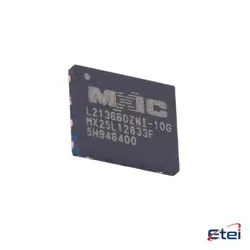
Abbildungen dienen nur als Referenz
GD25LQ128DSIG
+StücklisteIC FLASH 128MBIT SPI/QUAD 8SOP
-
HerstellerGigaDevice Semiconductor (HK) Limited
-
Herstellerteil #GD25LQ128DSIG
-
Paket SOIC-8
-
Auf Lager4713
365 Tage Qualitätsgarantie
7*24 Stunden-Servicegarantie
90-Tage Kundendienstgarantie
Originalproduktgarantie
Spezifikationen
| Attribut | Wert |
| Package | Tube |
| ProductStatus | Not For New Designs |
| MemoryType | Non-Volatile |
| MemoryFormat | FLASH |
| Technology | FLASH - NOR |
| MemorySize | 128Mb (16M x 8) |
| MemoryInterface | SPI - Quad I/O |
| ClockFrequency | 120 MHz |
| WriteCycleTime-WordPage | 2.4ms |
| Voltage-Supply | 1.65V ~ 2V |
| OperatingTemperature | -40°C ~ 85°C (TA) |
| MountingType | Surface Mount |
| Package/Case | 8-SOIC (0.209, 5.30mm Width) |
Übersicht
Description
Operating within a voltage range of 2.7V to 3.6V, this chip supports a Serial Peripheral Interface (SPI), making it compatible with numerous microcontrollers. The GD25LQ128DSIG offers dual and quad I/O operations for enhanced performance and faster data transfer rates. Key features include fast read times, low power consumption, and sector or block erase options, which are ideal for applications that require frequent data updates.
The chip is commonly used in consumer electronics, industrial applications, and embedded systems for data storage, firmware, and configuration settings. Its compact size and efficiency make it suitable for devices where space and energy savings are critical. The GD25LQ128DSIG is valued for its reliability, longevity, and performance in demanding environments.
Equivalent
1. Winbond W25Q128JV
2. Micron MT25QL128ABA
3. Macronix MX25L12835F
4. Cypress (Infineon) S25FL127S
5. ISSI IS25LP128
These equivalents offer similar storage capacity, interface, and performance characteristics, making them suitable substitutes in various applications. Always verify pin compatibility and electrical specifications before substituting.
Features
1. Interface: Utilizes a Serial Peripheral Interface (SPI) for communication, supporting Standard/Dual/Quad I/O SPI modes, which enhances data transfer rates.
2. Performance: Offers fast read speeds up to 133 MHz and supports Dual/Quad I/O for improved read throughput.
3. Low Power Consumption: Designed for low power usage, with deep power-down modes to conserve energy.
4. Wide Temperature Range: Operates effectively in a range of temperatures, typically from -40°C to +85°C, making it suitable for various environments.
5. Data Retention and Endurance: Provides up to 20-year data retention and high program/erase cycling endurance, generally 100,000 cycles.
6. Security Features: Includes features like status register protection and block protection to secure data.
7. Package: Available in multiple packaging options, such as SOP8, to accommodate different design requirements.
These features make the GD25LQ128DSIG suitable for a wide range of applications, including consumer electronics, industrial systems, and automotive applications.
Pinout
1. CS# (Chip Select): Activates the device when low.
2. DO (Data Out) / IO1: Serial data output in single mode and a bidirectional data line in dual/quad I/O modes.
3. WP# (Write Protect) / IO2: Protects the memory content and also acts as a bidirectional data line in quad I/O mode.
4. GND: Ground reference for power supply.
5. DI (Data In) / IO0: Serial data input in single mode and a bidirectional data line in dual/quad I/O modes.
6. CLK (Clock): Provides the clock signal for synchronous operations.
7. HOLD# / IO3: Pauses serial communication and also acts as a bidirectional data line in quad I/O mode.
8. VCC: Power supply pin.
This configuration allows the GD25LQ128DSIG to perform fast read and write operations, suitable for applications requiring reliable non-volatile storage.
Manufacturer
Application
1. Consumer Electronics: Used in devices like TVs, set-top boxes, and gaming consoles for firmware storage.
2. Industrial Automation: Provides reliable data logging and firmware updates in industrial control systems.
3. Automotive: Used for infotainment systems, navigation, and advanced driver-assistance systems (ADAS).
4. Networking Equipment: Stores firmware and configuration data for routers, switches, and other network devices.
5. IoT Devices: Supports firmware and data storage in smart devices and sensors.
6. Computing: Used in laptops, PCs, and servers for BIOS storage.
Its fast read/write capabilities and reliability make it ideal for these applications.