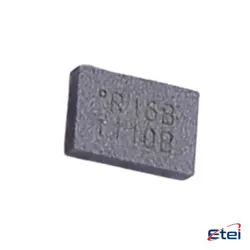
Abbildungen dienen nur als Referenz
HMC424ALP3ETR
+StücklisteRF ATTENUATOR 31.5DB 16VFQFN
-
HerstellerAnalog Devices Inc.
-
Herstellerteil #HMC424ALP3ETR
-
Datenblatt HMC424ALP3ETR DataSheet
-
Paket QFN EP
-
Auf Lager7178
365 Tage Qualitätsgarantie
7*24 Stunden-Servicegarantie
90-Tage Kundendienstgarantie
Originalproduktgarantie
Spezifikationen
| Attribut | Wert |
| Package | Tape & Reel (TR),Cut Tape (CT) |
| ProductStatus | Active |
| AttenuationValue | 31.5dB |
| FrequencyRange | 0 Hz ~ 13 GHz |
Übersicht
Description
Key features include low insertion loss, high isolation between ports, and fast switching speed. The switch is controlled via a TTL/CMOS compatible interface, which simplifies its integration into digital systems. It is packaged in a compact leadless 3x3 mm SMT (surface-mount technology) package, making it ideal for applications where space is a premium.
Typical applications of the HMC424ALP3ETR include wireless infrastructure, test equipment, and military and aerospace systems. Its robust performance across a wide frequency range and compact form factor make it a versatile component in RF signal routing and switching.
Equivalent
Features
Pinout
Here's a concise overview of its pin configuration and functions:
- Pin Count: 16 pins.
- Key Pins and Functions:
- RF1, RF2, RF3, RF4: These are the RF output ports.
- RFC: This is the common RF input/output port.
- V1, V2: Control voltage pins for switch operation.
- GND: Ground pins.
- VDD: Supply voltage pin.
- NC: No connection pins (ensure proper PCB layout as per the datasheet).
The switch is designed to handle frequencies from DC to 8 GHz, providing low insertion loss and high isolation. It is typically used in applications such as telecommunications, test equipment, and radar systems.
Manufacturer
Application
1. Wireless Infrastructure: Used in base stations and repeaters for signal conditioning and optimization.
2. Test and Measurement Equipment: Employed in RF testing equipment for precise signal attenuation.
3. Military and Aerospace: Utilized in communication systems for its robust performance in varying conditions.
4. Microwave Radio: Assists in signal adjustment in point-to-point and point-to-multipoint radio links.
5. Satellite Communications: Used for signal tuning and management in transponders.
These applications benefit from its high linearity, low insertion loss, and wide frequency range.