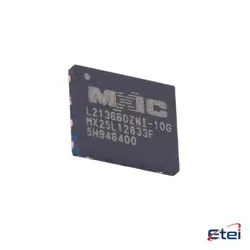
Abbildungen dienen nur als Referenz
M24C02-DRMN3TP/K
+StücklisteIC EEPROM 2KBIT I2C 1MHZ 8SO
-
HerstellerSTMikroelektronik
-
Herstellerteil #M24C02-DRMN3TP/K
-
Datenblatt M24C02-DRMN3TP/K DataSheet
-
Paket 8-SOIC
-
Auf Lager7737
365 Tage Qualitätsgarantie
7*24 Stunden-Servicegarantie
90-Tage Kundendienstgarantie
Originalproduktgarantie
Spezifikationen
| Attribut | Wert |
| Package | Tape & Reel (TR),Cut Tape (CT) |
| Series | Automotive, AEC-Q100 |
| ProductStatus | Active |
| MemoryType | Non-Volatile |
| MemoryFormat | EEPROM |
| Technology | EEPROM |
| MemorySize | 2Kb (256 x 8) |
| MemoryInterface | I²C |
| ClockFrequency | 1 MHz |
| WriteCycleTime-WordPage | 4ms |
| AccessTime | 450 ns |
| Voltage-Supply | 1.8V ~ 5.5V |
| OperatingTemperature | -40°C ~ 125°C (TA) |
| MountingType | Surface Mount |
| Package/Case | 8-SOIC (0.154, 3.90mm Width) |
Übersicht
Description
The EEPROM is organized as 256 x 8 bits, providing a total of 2048 bits of memory. It features byte and page write capabilities, with a page size of 16 bytes. The device includes data protection features such as a hardware write-protect pin to prevent accidental data overwriting.
Typical applications for the M24C02-DRMN3TP/K include data storage in consumer electronics, industrial systems, and communication devices. Its compact size and low power consumption make it suitable for portable and battery-operated devices. The EEPROM is available in various package options, including the TSSOP8, which ensures flexibility for different design requirements.
Equivalent
1. Atmel/Microchip 24C02 – A similar I2C EEPROM with 2Kb capacity.
2. ON Semiconductor CAT24C02 – Another 2Kb I2C EEPROM.
3. Microchip 24AA02/24LC02 – Variants of 2Kb EEPROMs.
4. ROHM BR24G02 – A 2Kb I2C EEPROM.
5. Renesas R1EX24002 – Similar 2Kb I2C EEPROM.
These alternatives provide comparable storage and interface functionalities.
Features
1. Memory Organization: 256 x 8 bits, allowing easy data organization and access.
2. Serial I2C Interface: Supports I2C protocol, compatible with 1 MHz Fast-mode Plus and 400 kHz Fast-mode.
3. Wide Operating Voltage: Operates from 1.7V to 5.5V, suitable for various applications.
4. Data Retention: Offers 40 years of data retention, ensuring long-term data storage.
5. Write Protection: Includes a hardware write-protect pin to safeguard data integrity.
6. EEPROM Write Time: Typical byte-write time is 5 ms, ensuring swift data updates.
7. Page Write Capability: Supports page write mode, up to 16 bytes at a time.
8. Endurance: Guarantees up to 1 million write/erase cycles per byte.
9. Extended Temperature Range: Operates from -40°C to +85°C, suitable for industrial environments.
10. Package Options: Available in various package types for flexible integration into designs.
These features make it ideal for applications requiring reliable, non-volatile memory storage with flexible interfacing capabilities.
Pinout
Here is a concise description of the pin functions:
1. VCC: Power supply pin.
2. GND: Ground pin.
3. SDA: Serial Data, used for both input and output. It is the data line in the I²C protocol.
4. SCL: Serial Clock, used to synchronize data transfer in the I²C protocol.
5. WC: Write Control, used to enable or disable write operations. When high, write operations are disabled.
6. A0, A1, A2: Address pins, used to set the hardware address of the device, allowing up to 8 devices on the same I²C bus.
These pins facilitate communication and control of the EEPROM via the I²C bus, allowing for data storage and retrieval. The chip's small size and versatility make it suitable for various applications requiring non-volatile memory.
Manufacturer
STMicroelectronics is known for its focus on innovation and sustainability, with a strong emphasis on research and development to produce cutting-edge technology solutions. It operates in a highly competitive market and collaborates with numerous partners to address the needs of its diverse customer base. The company is headquartered in Geneva, Switzerland, and has a significant presence worldwide, with numerous manufacturing facilities, design centers, and sales offices across different countries.
Application
1. Consumer electronics: Storing configuration settings and user preferences.
2. Industrial systems: Logging data and storing calibration information.
3. Automotive: Retaining system settings and diagnostic data.
4. Medical devices: Maintaining patient data records and device settings.
5. Communication equipment: Configuration and network settings storage.
6. Computer peripherals: Storing firmware or user settings.
7. IoT devices: Retaining device identities and settings.
Its low power consumption, small size, and reliable performance make it suitable for these varied applications.