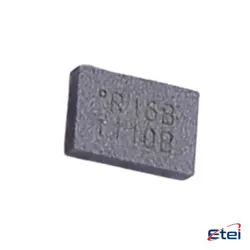
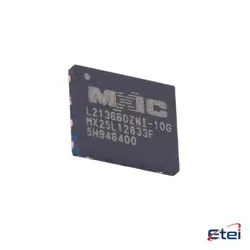
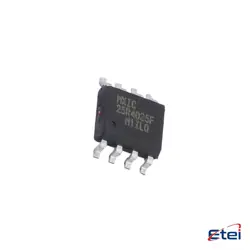
Abbildungen dienen nur als Referenz
M24C16-RMN6TP
+StücklisteIC EEPROM 16KBIT I2C 400KHZ 8SO
-
HerstellerSTMikroelektronik
-
Herstellerteil #M24C16-RMN6TP
-
Datenblatt M24C16-RMN6TP DataSheet
-
Paket SO-8
-
Auf Lager3739
365 Tage Qualitätsgarantie
7*24 Stunden-Servicegarantie
90-Tage Kundendienstgarantie
Originalproduktgarantie
Spezifikationen
| Attribut | Wert |
| Package | Tape & Reel (TR),Cut Tape (CT) |
| ProductStatus | Active |
| MemoryType | Non-Volatile |
| MemoryFormat | EEPROM |
| Technology | EEPROM |
| MemorySize | 16Kb (2K x 8) |
| MemoryInterface | I²C |
| ClockFrequency | 400 kHz |
| WriteCycleTime-WordPage | 5ms |
| AccessTime | 900 ns |
| Voltage-Supply | 1.8V ~ 5.5V |
| OperatingTemperature | -40°C ~ 85°C (TA) |
| MountingType | Surface Mount |
| Package/Case | 8-SOIC (0.154, 3.90mm Width) |
Übersicht
Description
Key features of the M24C16-RMN6TP include a supply voltage range from 2.5V to 5.5V, more than 1 million write cycles, and data retention of over 40 years, ensuring durability and reliability. Its small size and low power consumption make it ideal for various applications, including industrial, automotive, and consumer electronics. The "RMN6TP" suffix indicates its specific package type and temperature range, which is a standard configuration for compatibility and ease of integration in electronic designs.
Equivalent
1. AT24C16 - Microchip Technology
2. CAT24C16 - ON Semiconductor
3. 24LC16B - Microchip Technology
4. BR24G16 - ROHM Semiconductor
These alternatives generally offer similar specifications, such as memory size, communication interface, and operating voltage ranges, making them suitable replacements depending on specific requirements. Always verify pin compatibility and electrical characteristics before substitution.
Features
1. Memory Organization: It offers a 16-Kbit capacity, organized as 2048 x 8 bits.
2. Interface: The device supports I2C communication, adhering to the fast-mode (400 kHz) and standard-mode (100 kHz) protocols.
3. Wide Voltage Range: It operates over a supply voltage range of 2.5V to 5.5V.
4. Data Retention and Endurance: The EEPROM guarantees data retention for more than 40 years and offers write endurance of up to 1 million cycles.
5. Write Protection: Features a hardware write-protect pin to secure the entire memory content against accidental overwrites.
6. Operating Temperature: It is suitable for industrial applications, with an operating temperature range from -40°C to +85°C.
7. Package Type: The device is available in an SO8 (150 mils) package, making it suitable for various compact design requirements.
These features make the M24C16-RMN6TP a reliable choice for applications requiring non-volatile memory storage with robust performance and protection.
Pinout
The device comes in an 8-pin package, and its pin functions are as follows:
1. A0, A1, A2: These are address pins used for hardware addressing to select the device when multiple devices are on the same I²C bus.
2. VSS (Ground): The ground reference for the device.
3. SDA (Serial Data): Bidirectional data line for I²C communication. It transfers data in and out of the device.
4. SCL (Serial Clock): Clock line for I²C communication. It synchronizes the data transfer between the EEPROM and the microcontroller.
5. WP (Write Protect): This pin is used to enable or disable write protection for part of the memory array.
6. VCC (Power Supply): The voltage supply pin.
These functions enable the EEPROM to interface with microcontrollers over an I²C bus for data storage tasks.
Manufacturer
Application
1. Consumer Electronics: Used for storing user settings and configurations.
2. Automotive: Employed for data logging and parameter storage in control units.
3. Industrial Systems: Ideal for calibration data and process control settings.
4. Medical Devices: Utilized for storing patient information and device configurations.
5. Computing: Serves in BIOS settings, configuration storage, and peripheral interfacing.
6. Communication: Used in network devices for storing firmware and configuration data.
These applications benefit from the EEPROM's non-volatile memory, low power consumption, and I2C interface.