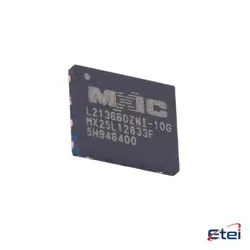
Abbildungen dienen nur als Referenz
M24C64-DRMN3TP/K
+StücklisteIC EEPROM 64KBIT I2C 1MHZ 8SO
-
HerstellerSTMikroelektronik
-
Herstellerteil #M24C64-DRMN3TP/K
-
Datenblatt M24C64-DRMN3TP/K DataSheet
-
Paket SO-8
-
Auf Lager4403
365 Tage Qualitätsgarantie
7*24 Stunden-Servicegarantie
90-Tage Kundendienstgarantie
Originalproduktgarantie
Spezifikationen
| Attribut | Wert |
| Package | Tape & Reel (TR),Cut Tape (CT) |
| Series | Automotive, AEC-Q100 |
| ProductStatus | Active |
| MemoryType | Non-Volatile |
| MemoryFormat | EEPROM |
| Technology | EEPROM |
| MemorySize | 64Kb (8K x 8) |
| MemoryInterface | I²C |
| ClockFrequency | 1 MHz |
| WriteCycleTime-WordPage | 4ms |
| AccessTime | 450 ns |
| Voltage-Supply | 1.8V ~ 5.5V |
| OperatingTemperature | -40°C ~ 125°C (TA) |
| MountingType | Surface Mount |
| Package/Case | 8-SOIC (0.154, 3.90mm Width) |
Übersicht
Description
The device features a standard I²C interface with a two-wire serial protocol, which allows for efficient communication with microcontrollers and other I²C-enabled devices. It supports both random and sequential read operations, and write operations include byte write and page write capabilities, with page sizes up to 32 bytes.
The M24C64-DRMN3TP/K offers a high endurance of up to 1 million write cycles per byte and more than 40 years of data retention, ensuring reliability in critical applications. In addition, it incorporates write protection features to safeguard data integrity. The EEPROM is housed in a compact, lead-free package, making it suitable for space-constrained designs.
Equivalent
1. AT24C64 from Microchip Technology (formerly Atmel)
2. 24LC64 from Microchip Technology
3. CAT24C64 from ON Semiconductor
4. BR24G64 from ROHM Semiconductor
These alternatives offer similar functionalities and specifications, such as memory size and I2C interface, making them potential substitutes. Always verify the specific features and compatibility for your application before selecting an equivalent.
Features
1. Memory Organization: 8 Kbytes of memory organized as 256 pages of 32 bytes each.
2. I²C Interface: Supports Standard (100 kHz), Fast (400 kHz), Fast-plus (1 MHz), and Ultra Fast (5 MHz) modes.
3. Wide Voltage Range: Operates over a supply voltage range from 1.7V to 5.5V.
4. Data Retention: Offers a data retention period of more than 200 years.
5. Endurance: Supports up to 4 million write cycles per byte.
6. Write Protection: Includes a write protection mechanism for the entire memory area.
7. Operating Temperature: Can function within a temperature range of -40°C to +85°C.
8. Package Options: Available in a variety of compact packages for flexible design integration.
9. Low Power Consumption: Features low active and standby current consumption for energy-efficient applications.
These features make it suitable for a wide range of applications, including consumer electronics, industrial controls, and automotive systems.
Pinout
1. A0, A1, A2: Device address inputs. These pins are used to set the device address when multiple EEPROMs are connected to the same I2C bus.
2. VSS: Ground reference for the device.
3. SDA: Serial Data. This pin is used for bi-directional data transfer between the EEPROM and the I2C controller.
4. SCL: Serial Clock. This input is used to synchronize data transfer on the I2C bus.
5. WC: Write Control. This pin can be used to enable or disable write operations to the EEPROM.
6. VCC: Power supply pin.
The device uses the I2C protocol for communication, allowing for easy interfacing with microcontrollers and other digital devices.
Manufacturer
Application
1. Consumer Electronics: For storing configuration settings and user preferences.
2. Industrial Automation: Used in system calibration and data logging.
3. Automotive Systems: For engine control units and infotainment systems to store system data and configurations.
4. Medical Devices: In patient monitoring systems for data storage.
5. IoT Devices: For identity storage and configuration data retention.
The EEPROM's I2C interface and low-power consumption make it suitable for embedded systems where efficient, reliable, and compact data storage is required.