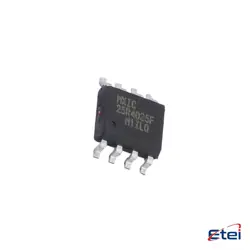
Abbildungen dienen nur als Referenz
M28W160CT70N6E
+Stückliste2.7V~3.6V 16Mbit TSOP-48 Memory (ICs) RoHS
-
HerstellerMicron
-
Herstellerteil #M28W160CT70N6E
-
Datenblatt M28W160CT70N6E DataSheet
-
Auf Lager8423
365 Tage Qualitätsgarantie
7*24 Stunden-Servicegarantie
90-Tage Kundendienstgarantie
Originalproduktgarantie
Spezifikationen
| Attribut | Wert |
| Packaging | TSOP-48 |
| MemorySize | 16Mbit |
| Operatingtemperature | -40℃~+85℃ |
| Voltage-Supply | 2.7V~3.6V |
| DataRetention-TDR(Year) | 20 Years |
| PageProgrammingTime(Tpp) | 70ns |
| Program/EraseCycles | 100,000 cycles |
| StandbySupplyCurrent | 0.2uA |
Übersicht
Description
This flash memory is used in various applications, including embedded systems, consumer electronics, and industrial devices, offering non-volatile storage, meaning it retains data without power. Its structure allows for efficient reading, writing, and erasing operations, making it ideal for applications requiring frequent updates and data management. The device typically operates over a wide temperature range and supports rapid access times, ensuring smooth device performance. Overall, the M28W160CT70N6E is valued for its stability and effectiveness in demanding electronic environments.
Equivalent
Features
1. Architecture: Composed of 16 uniform 64 Kb sectors, offering flexible sector erase and reprogramming functionality.
2. Performance: Offers a fast access time of 70 ns, making it suitable for high-speed applications.
3. Technology: Built using advanced CMOS technology, ensuring low power consumption and reliable performance.
4. Program and Erase Cycles: Supports robust endurance with up to 100,000 program/erase cycles per sector.
5. Voltage: Operates with a single 2.7V to 3.6V VCC, simplifying power supply design.
6. Data Retention: Guarantees data retention for up to 20 years, ensuring long-term reliability.
7. Security: Includes a 64-bit unique device identifier for enhanced security.
8. Packaging: Available in TSOP packages, making it suitable for space-constrained applications.
This flash memory is ideal for applications requiring reliable, high-speed data storage with the flexibility of sector-specific erase and programming.
Pinout
The pin functions include:
- Address Inputs (A0-A19): These pins are used to select the memory address.
- Data Inputs/Outputs (DQ0-DQ15): These are bidirectional pins used to input data to or output data from the memory.
- Chip Enable (E#): Enables the device for reading or programming.
- Output Enable (G#): Controls the data output buffers, allowing data to be read.
- Write Enable (W#): Used to write data into the memory.
- Reset (RP#): Resets the memory, bringing it to standby mode.
- Byte/Word Organization Select (BYTE#): Selects whether the device operates in byte mode (x8) or word mode (x16).
Power supply and ground pins are also included to power the device and provide a reference point for voltage levels. The device supports a variety of operations including read, program, and erase functions.
Manufacturer
Application
Package
Frequently Asked Questions
Q: What is the memory density and package type of the M28W160CT70N6E?
A: It has a 16Mbit memory size housed in a TSOP-48 package, suitable for surface-mount applications requiring compact design.
Q: What is the operating voltage range for this Micron memory device?
A: The voltage supply range is 2.7V to 3.6V, making it compatible with standard 3.3V logic systems.
Q: What is the expected data retention and endurance life?
A: It offers 20 years of data retention and supports 100,000 program/erase cycles, ensuring long-term reliability.
Q: Is this component suitable for industrial temperature environments?
A: Yes, it operates over -40°C to +85°C, ideal for industrial and automotive applications with harsh conditions.
Q: How fast is the page programming time for this memory?
A: The page programming time (Tpp) is 70ns, allowing efficient high-speed write operations for firmware updates.
Q: What is the standby power consumption of this device?
A: The standby supply current is only 0.2µA, minimizing power draw in battery-powered or low-power systems.