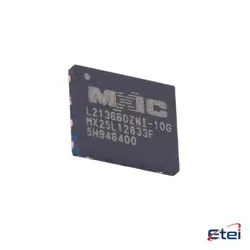
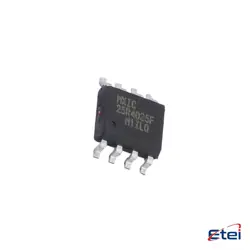
Abbildungen dienen nur als Referenz
M95128-RMN6TP
+StücklisteIC EEPROM 128KBIT SPI 20MHZ 8SO
-
HerstellerSTMikroelektronik
-
Herstellerteil #M95128-RMN6TP
-
Datenblatt M95128-RMN6TP DataSheet
-
Paket SO8
-
Auf Lager4292
365 Tage Qualitätsgarantie
7*24 Stunden-Servicegarantie
90-Tage Kundendienstgarantie
Originalproduktgarantie
Spezifikationen
| Attribut | Wert |
| Package | Tape & Reel (TR),Cut Tape (CT) |
| ProductStatus | Active |
| MemoryType | Non-Volatile |
| MemoryFormat | EEPROM |
| Technology | EEPROM |
| MemorySize | 128Kb (16K x 8) |
| MemoryInterface | SPI |
| ClockFrequency | 20 MHz |
| WriteCycleTime-WordPage | 5ms |
| Voltage-Supply | 1.8V ~ 5.5V |
| OperatingTemperature | -40°C ~ 85°C (TA) |
| MountingType | Surface Mount |
| Package/Case | 8-SOIC (0.154, 3.90mm Width) |
Übersicht
Description
Key features include low power consumption, high-speed operation, and a built-in hardware write protection mechanism to prevent accidental data overwrites. The M95128-RMN6TP is suitable for use in a variety of applications such as data storage, configuration settings, and calibration data in consumer electronics, industrial equipment, and automotive systems. Its small package size makes it ideal for space-constrained applications. Additionally, its operational temperature range makes it versatile for both general and industrial environments.
Equivalent
1. Microchip 25LC128
2. Atmel/Microchip AT25128
3. Macronix MX25L128
These alternatives provide similar memory capacities and communication protocols, though specific features and operating conditions might vary. Always check the datasheets to ensure compatibility with your specific application requirements.
Features
1. Memory Organization: It offers 16,384 bytes of memory organized in a single block.
2. Interface: Utilizes an SPI (Serial Peripheral Interface) bus for communication, making it compatible with a wide range of microcontrollers and processors.
3. Data Retention: Provides reliable data retention with capabilities up to 40 years, ensuring data integrity over long periods.
4. Write Protection: Includes write protection features, safeguarding data against unintentional writes.
5. Low Power Consumption: Operates efficiently with low power requirements, making it suitable for battery-powered and energy-sensitive applications.
6. Operating Voltage: Supports a wide operating voltage range, typically from 1.8V to 5.5V, offering flexibility in various system designs.
7. Temperature Range: Designed to function efficiently across a broad temperature range, often from -40°C to +85°C, for use in different environmental conditions.
8. Package Type: Available in various compact packaging options, suitable for space-constrained applications.
These features make the M95128-RMN6TP ideal for use in consumer electronics, industrial controls, and automotive applications.
Pinout
1. VCC: Power supply pin.
2. GND: Ground pin.
3. SCL (Serial Clock Line): Used to synchronize communication between the microcontroller and the EEPROM.
4. SDA (Serial Data Line): Used for bi-directional data transfer.
5. WP (Write Protect): Used to enable or disable write protection.
6. HOLD: Used to pause any serial communication without resetting the serial sequence.
7. NC (No Connection): Typically not connected internally and may be left floating.
8. NC (No Connection): Another pin that is typically not connected and may be left floating.
The device utilizes an I2C bus protocol for communication, supporting both standard (100 kHz) and fast (400 kHz) modes. It is commonly used for data storage applications requiring non-volatile memory.
Manufacturer
Application
1. Consumer Electronics: Used for storing firmware, configuration settings, and calibration data.
2. Industrial Automation: Stores control parameters and data logging information.
3. Automotive Systems: Utilized in settings storage and sensor data logging for ECUs.
4. Medical Devices: Keeps configuration and user settings.
5. Communications Equipment: Stores network configurations and operational data.
6. Embedded Systems: Often used for small-scale data logging and non-volatile storage needs.
These areas leverage the EEPROM's reliable non-volatile memory, compact size, and efficient data retention capabilities.