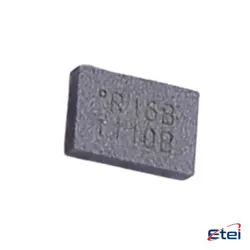
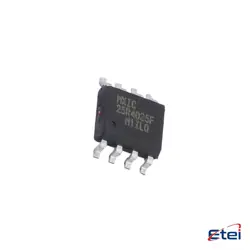
Abbildungen dienen nur als Referenz
MCP23017-E/ML
+StücklisteIC I/O EXPANDER I2C 16B 28QFN
-
HerstellerMikrochip-Technologie
-
Herstellerteil #MCP23017-E/ML
-
Paket QFN-28
-
Auf Lager7719
365 Tage Qualitätsgarantie
7*24 Stunden-Servicegarantie
90-Tage Kundendienstgarantie
Originalproduktgarantie
Spezifikationen
| Attribut | Wert |
| Package / Case | Tube |
| Part Status | Active |
| Number of I/O | 16 |
| Interface | I²C |
| Interrupt Output | Yes |
| Features | POR |
| Output Type | Push-Pull |
| Current - Output Source / Sink | 25mA |
| Clock Frequency | 1.7 MHz |
| Voltage - Supply | 1.8V ~ 5.5V |
| Operating Temperature | -40°C ~ 125°C |
| Mounting Type | Surface Mount |
Übersicht
Description
The MCP23017-E/ML is equipped with three hardware address pins, enabling up to eight devices on the same I2C bus. It includes internal pull-up resistors and supports high-speed I2C communication at up to 1.7 MHz. The device's interrupt output can be configured to activate on pin state changes, improving response in real-time applications. Its small ML package (QFN-28) is space-efficient, making it ideal for compact designs. Overall, the MCP23017-E/ML offers a flexible solution to expand the I/O capabilities of microcontroller systems in a user-friendly manner.
Equivalent
1. MCP23008: Also from Microchip, with 8-bit I/O.
2. PCF8575: From NXP, offering similar 16-bit I/O expansion via I2C.
3. PCAL9555A: Another option from NXP, a 16-bit I/O expander with interrupt capability.
4. PCA9535: Also from NXP, providing similar functionality with I2C interface.
These alternatives vary in features, so ensure compatibility with your specific application needs.
Features
1. I2C Interface: Supports I2C communication, allowing easy integration with microcontrollers for extending the number of I/O pins.
2. 16 I/O Pins: Offers 16 bidirectional input/output pins, organized in two 8-bit ports (Port A and Port B).
3. Interrupt Capability: Each I/O port can be configured to generate interrupts on state changes, with separate interrupt outputs for each port.
4. Configurable I/O: Pins can be configured individually as inputs or outputs, and internal pull-up resistors can be enabled on inputs.
5. Addressing: Features three hardware address pins, allowing for up to eight devices on the same bus.
6. Operating Voltage: Supports a wide voltage range from 1.8V to 5.5V.
7. Package: Available in a 28-pin QFN package (ML suffix).
8. Low Power Consumption: Designed to be power-efficient, suitable for battery-operated applications.
9. Versatile Applications: Ideal for adding I/O capabilities to microcontrollers in various applications, including switches, LEDs, sensors, and more.
These features make the MCP23017-E/ML a flexible and versatile choice for expanding I/O resources in embedded systems.
Pinout
Key functions and features include:
- I2C Interface: Allows easy communication with microcontrollers using two lines, SDA (Serial Data) and SCL (Serial Clock).
- 16 GPIO Pins: Provides two 8-bit ports (PORTA and PORTB) for digital input/output, which can be configured individually as inputs or outputs.
- Interrupts: Features interrupt-on-change capability for each pin, useful for detecting changes on input pins.
- Addressing: Supports up to eight devices on the same I2C bus using three hardware address pins.
- Internal Pull-up Resistors: Optional pull-up resistors on each pin can be enabled.
- Operating Voltage: Typically operates at 1.8V to 5.5V.
The MCP23017 is commonly used in applications requiring additional I/O ports, like home automation and industrial control systems.
Manufacturer
Application
1. Home Automation: For controlling lights, switches, and sensors.
2. Industrial Control Systems: Extending I/O for machinery and process control.
3. Consumer Electronics: Enhancing user interface options with additional buttons and LEDs.
4. Robotics: Managing sensors and actuators.
5. IoT Devices: Expanding connectivity and control capabilities.
6. Embedded Systems: General-purpose I/O expansion for custom hardware.
Its versatility makes it suitable for any application needing increased digital interfaces.