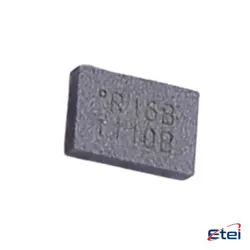
Abbildungen dienen nur als Referenz
MCP3424-E/SL
+StücklisteIC ADC 18BIT SIGMA-DELTA 14SOIC
-
HerstellerMikrochip-Technologie
-
Herstellerteil #MCP3424-E/SL
-
Datenblatt MCP3424-E/SL DataSheet
-
Paket SOIC-14
-
Auf Lager6703
365 Tage Qualitätsgarantie
7*24 Stunden-Servicegarantie
90-Tage Kundendienstgarantie
Originalproduktgarantie
Spezifikationen
| Attribut | Wert |
| Package / Case | Tube |
| Part Status | Active |
| Number of Bits | 18 |
| Sampling Rate(Per Second) | 3.75 |
| Number of Inputs | 4 |
| Input Type | Differential |
| Data Interface | I²C |
| Configuration | MUX-PGA-ADC |
| Number of A/D Converters | 1 |
| Architecture | Sigma-Delta |
| Reference Type | Internal |
| Voltage - Supply, Analog | 2.7V ~ 5.5V |
| Voltage - Supply, Digital | 2.7V ~ 5.5V |
| Features | PGA, Selectable Address |
| Operating Temperature | -40°C ~ 125°C |
| Supplier Device Package | 14-SOIC |
Übersicht
Description
Key features include programmable gain amplifier (PGA) settings with gains up to 8x, which enhance low-level signal measurement capabilities. It offers continuous and one-shot conversion modes, allowing for power-efficient operation tailored to specific application needs. The ADC operates on a supply voltage ranging from 2.7V to 5.5V and supports data rates from 240 SPS to 3.75 SPS, which can be adjusted depending on the resolution and speed requirements.
The MCP3424 is ideal for applications in industrial, consumer, and medical fields where high accuracy and low noise are critical. Its compact size and low power consumption make it versatile for embedded systems and portable devices.
Equivalent
1. Texas Instruments ADS1115 - a 4-channel, 16-bit ADC.
2. Analog Devices AD7124-4 - a 4-channel, 24-bit ADC.
3. Maxim Integrated MAX11254 - a 6-channel, 24-bit ADC.
4. NXP Semiconductor PCA9534 - a 4-channel, 8-bit ADC, though with lower resolution.
Note that differences in specifications like resolution, channel count, and features may exist.
Features
1. Resolution and Channels: It offers 18-bit resolution and includes four differential input channels, making it suitable for multi-channel data acquisition.
2. Programmable Gain Amplifier (PGA): The PGA offers gains of 1, 2, 4, or 8, which enhances the flexibility in measuring small sensor signals.
3. I²C Interface: The device supports an I²C interface for easy integration with microcontrollers, allowing for efficient communication and control.
4. Selectable Conversion Speed: Users can select between different conversion speeds (3.75, 15, 60, or 240 samples per second), balancing between speed and resolution.
5. Automatic Internal Offset and Gain Calibration: This feature ensures high accuracy and reliability over time and varying conditions.
6. Low Power Consumption: It is designed to operate with minimal power, making it ideal for battery-powered applications.
7. Wide Operating Voltage Range: The MCP3424-E/SL operates from 2.7V to 5.5V, providing flexibility for various power supply configurations.
Pinout
1. VDD: Power supply pin.
2. VIN1: Analog input channel 1.
3. VIN2: Analog input channel 2.
4. VIN3: Analog input channel 3.
5. VIN4: Analog input channel 4.
6. SCL: I2C clock line.
7. SDA: I2C data line.
8. ADDR: I2C address selection pin.
9. GND: Ground reference.
10. NC: No connection.
The MCP3424-E/SL is used for precise, low-frequency signal digitization, offering programmable gains and continuous or one-shot conversion modes, making it suitable for various applications requiring high-resolution measurements.
Manufacturer
Application
1. Sensor Interfaces: Ideal for interfacing with various sensors like temperature, pressure, and load sensors.
2. Data Logging: Suitable for recording environmental data over time.
3. Industrial Automation: Used for monitoring and controlling industrial processes.
4. Medical Instrumentation: Useful in medical devices for precise measurement and diagnostics.
5. Energy Management: Employed in power monitoring systems.
6. Consumer Electronics: Utilized in devices requiring accurate analog signal conversion.
Overall, the MCP3424-E/SL serves applications demanding high-resolution and low-noise ADC capabilities.