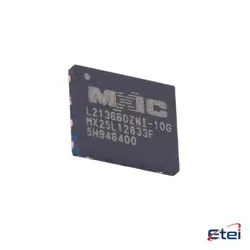
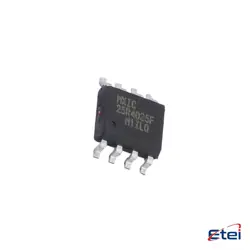
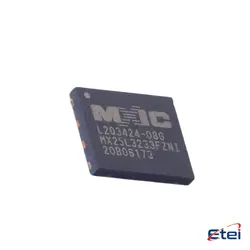
Abbildungen dienen nur als Referenz
MK60DN512ZVLQ10
+StücklisteIC MCU 32BIT 512KB FLASH 144LQFP
-
HerstellerHalbleiter im freien Maßstab
-
Herstellerteil #MK60DN512ZVLQ10
-
Datenblatt MK60DN512ZVLQ10 DataSheet
-
Paket SOT486-2
-
Auf Lager3032
365 Tage Qualitätsgarantie
7*24 Stunden-Servicegarantie
90-Tage Kundendienstgarantie
Originalproduktgarantie
Spezifikationen
| Attribut | Wert |
| Package / Case | Tray |
| Series | Kinetis K60 |
| Part Status | Active |
| Core Processor | ARM® Cortex®-M4 |
| Core Size | 32-Bit Single-Core |
| Speed | 100MHz |
| Connectivity | CANbus, EBI/EMI, Ethernet, I²C, IrDA, SD, SPI, UART/USART, USB, USB OTG |
| Peripherals | DMA, I²S, LVD, POR, PWM, WDT |
| Number of I/O | 100 |
| Program Memory Size | 512KB (512K x 8) |
| Program Memory Type | FLASH |
| RAM Size | 128K x 8 |
| Voltage - Supply (Vcc/Vdd) | 1.71V ~ 3.6V |
| Data Converters | A/D 42x16b; D/A 2x12b |
| Oscillator Type | Internal |
| Operating Temperature | -40°C ~ 105°C (TA) |
| Mounting Type | Surface Mount |
Übersicht
Description
The MK60DN512ZVLQ10 is equipped with a wide array of peripherals, including multiple timers, ADCs (Analog-to-Digital Converters), DACs (Digital-to-Analog Converters), and communication interfaces such as UART, SPI, I2C, and USB. This makes it highly versatile for various applications, from industrial automation to consumer electronics.
Furthermore, the microcontroller supports advanced low power features and multiple operational modes, making it suitable for energy-efficient designs. Its package type, LQFP (Low-Profile Quad Flat Package), facilitates integration into circuit boards for diverse embedded systems.
Equivalent
1. STM32F407 series from STMicroelectronics
2. ATSAM4E series from Microchip Technology (formerly Atmel)
3. LPC1768 series from NXP (for Cortex-M3 alternative)
4. TM4C123 series from Texas Instruments
Choosing an equivalent would depend on the specific requirements like peripherals, power consumption, and pin compatibility.
Features
1. Core: It is based on the ARM Cortex-M4 core, operating at up to 100 MHz.
2. Memory: Includes 512 KB of Flash memory and 128 KB of SRAM.
3. Performance: Offers a high-performance architecture with DSP instructions and a floating-point unit.
4. Connectivity: Supports multiple communication interfaces, including Ethernet, USB On-The-Go with PHY, CAN, I2C, SPI, UART, and I2S.
5. Timers: Features multiple timers, including PWM and a quadrature encoder.
6. Analog Features: Includes a 16-bit ADC, 12-bit DAC, and voltage reference.
7. Low Power: Offers various low-power modes for energy efficiency.
8. Security: Provides hardware encryption and a random number generator for secure operations.
9. Package: Comes in a 144-pin LQFP package.
10. Additional Features: Includes a comprehensive set of peripherals and a flexible clocking system.
These features make the MK60DN512ZVLQ10 suitable for a wide range of applications, including industrial control, medical devices, and consumer electronics.
Pinout
### Pin Count:
- 144 pins
### Key Functions:
1. CPU: ARM Cortex-M4 core with DSP instructions and a Floating Point Unit (FPU).
2. Memory:
- 512 KB Flash memory.
- 128 KB SRAM.
3. Peripherals:
- Multiple GPIOs.
- Several communication interfaces including UART, I2C, SPI.
- USB 2.0 Full-Speed/Low-Speed OTG controller.
- CAN module for automotive communication.
4. Timers and PWM: Various timers and PWM modules for control applications.
5. Analog: 16-bit ADCs, 12-bit DAC, and analog comparators.
6. Security: Hardware CRC and random number generator.
7. Clocks: Multiple clock sources and PLL for clock management.
This microcontroller is suitable for applications requiring significant processing power combined with extensive peripheral and memory capabilities.
Manufacturer
Application
1. Industrial Automation: Controls and monitors machinery, enhancing efficiency and safety.
2. Consumer Electronics: Powers smart home devices, home automation systems, and IoT gadgets.
3. Automotive Systems: Manages infotainment systems, advanced driver-assistance systems (ADAS), and body electronics.
4. Healthcare Devices: Supports medical equipment, wearable health monitors, and diagnostic tools.
5. Embedded Systems: Utilized in robotics, drones, and other embedded applications requiring real-time processing.
6. Networking Equipment: Implements communication protocols and network management functions.
These applications leverage its features like high performance, connectivity options, and low power consumption.