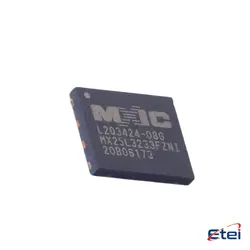
Abbildungen dienen nur als Referenz
MX29LV320ETXEI-70G
+StücklisteIC FLASH 32MBIT PARALLEL 48LFBGA
-
HerstellerMakronix
-
Herstellerteil #MX29LV320ETXEI-70G
-
Auf Lager8747
365 Tage Qualitätsgarantie
7*24 Stunden-Servicegarantie
90-Tage Kundendienstgarantie
Originalproduktgarantie
Spezifikationen
| Attribut | Wert |
| Series | MX29LV |
| PartStatus | Active |
| DigiKeyProgrammable | Not Verified |
| MemoryType | Non-Volatile |
| MemoryFormat | FLASH |
| Technology | FLASH - NOR |
| MemorySize | 32Mbit |
| MemoryOrganization | 4M x 8 |
| MemoryInterface | Parallel |
| WriteCycleTime-Word,Page | 70ns |
| Voltage-Supply | 2.7V ~ 3.6V |
| OperatingTemperature | -40°C ~ 85°C (TA) |
| MountingType | Surface Mount |
| Package/Case | 48-LFBGA, CSPBGA |
| SupplierDevicePackage | 48-LFBGA, CSP (6x8) |
| BaseProductNumber | MX29LV320 |
| AccessTime | 70 ns |
Übersicht
Description
The MX29LV320ETXEI-70G is a 32-megabit (4 megabytes) flash memory chip produced by Macronix. It belongs to the MX29LV series, known for its low voltage and high performance. This specific chip operates at a voltage range of 2.7V to 3.6V, making it suitable for battery-powered applications. With a 70-nanosecond access time, it offers fast read speeds, enhancing system performance.
The device features a boot sector architecture, which includes top and bottom boot block options, making it ideal for applications requiring code storage and execution. It supports both x8 and x16 data bus configurations, providing flexibility for different system designs. The chip employs CMOS process technology, ensuring low power consumption and high endurance.
The MX29LV320ETXEI-70G is commonly used in embedded systems, consumer electronics, and communication devices, where reliable and efficient non-volatile memory is needed. Its compact form factor and robust performance make it a popular choice for designers looking to integrate flash memory into their products.
The device features a boot sector architecture, which includes top and bottom boot block options, making it ideal for applications requiring code storage and execution. It supports both x8 and x16 data bus configurations, providing flexibility for different system designs. The chip employs CMOS process technology, ensuring low power consumption and high endurance.
The MX29LV320ETXEI-70G is commonly used in embedded systems, consumer electronics, and communication devices, where reliable and efficient non-volatile memory is needed. Its compact form factor and robust performance make it a popular choice for designers looking to integrate flash memory into their products.
Equivalent
The MX29LV320ETXEI-70G is a 32Mb Flash memory chip by Macronix. Equivalent products can include:
1. Spansion S29GL032N - 32Mb NOR Flash
2. Micron MT28F320J3 - 32Mb Parallel NOR Flash
3. Winbond W29GL032C - 32Mb NOR Flash
4. SST39VF3201 - 32Mb Multi-Purpose Flash
5. AMIC A29DL32X - 32Mb NOR Flash
These equivalents offer similar storage and interface capabilities. Always verify specific application requirements and compatibility before substitution.
1. Spansion S29GL032N - 32Mb NOR Flash
2. Micron MT28F320J3 - 32Mb Parallel NOR Flash
3. Winbond W29GL032C - 32Mb NOR Flash
4. SST39VF3201 - 32Mb Multi-Purpose Flash
5. AMIC A29DL32X - 32Mb NOR Flash
These equivalents offer similar storage and interface capabilities. Always verify specific application requirements and compatibility before substitution.
Features
The MX29LV320ETXEI-70G is a 32-megabit flash memory chip manufactured by Macronix. It features a fast access time of 70 nanoseconds, which makes it suitable for high-speed applications. The chip operates on a single 3.0V to 3.6V power supply, offering low power consumption. It uses a NOR-type flash architecture, ensuring fast read speeds and reliable data retention.
The device supports 8-bit and 16-bit data bus operations, providing flexibility in system integration. It features sector-based architecture with block protection, enabling selective data protection and efficient updates. The chip includes command set compatibility with standard flash devices, facilitating ease of use in various applications.
Additional features include a 100,000 program/erase cycle endurance per sector, ensuring longevity and durability. It also has an extended temperature range of -40°C to +85°C, making it suitable for industrial applications. The chip comes in a TSOP-48 package, optimizing space for circuit board design. Overall, the MX29LV320ETXEI-70G offers high performance and reliability for embedded systems, consumer electronics, and industrial applications.
The device supports 8-bit and 16-bit data bus operations, providing flexibility in system integration. It features sector-based architecture with block protection, enabling selective data protection and efficient updates. The chip includes command set compatibility with standard flash devices, facilitating ease of use in various applications.
Additional features include a 100,000 program/erase cycle endurance per sector, ensuring longevity and durability. It also has an extended temperature range of -40°C to +85°C, making it suitable for industrial applications. The chip comes in a TSOP-48 package, optimizing space for circuit board design. Overall, the MX29LV320ETXEI-70G offers high performance and reliability for embedded systems, consumer electronics, and industrial applications.
Pinout
The MX29LV320ETXEI-70G is a 32-megabit (4 megabytes) flash memory chip produced by Macronix. It features a 48-pin TSOP (Thin Small Outline Package) for surface mounting. The device operates with a 3-volt power supply.
The pin functions of the MX29LV320ETXEI-70G typically include:
1. Address Pins (A0-A20): Used to select specific memory addresses.
2. Data Pins (DQ0-DQ15): Used for data input/output operations.
3. Chip Enable (CE#): Activates the chip for read/write operations.
4. Output Enable (OE#): Controls data output from the chip.
5. Write Enable (WE#): Facilitates data writing to the chip.
6. Reset (RESET#): Resets the device.
7. Write Protect (WP#): Provides hardware protection for memory sectors.
8. Byte/Word Mode Select (BYTE#): Chooses between 8-bit and 16-bit data modes.
9. Power and Ground (VCC, GND): Power supply and ground connections.
These pins collectively enable the read, write, and erase functionalities of the flash memory, suitable for applications like code storage in embedded systems. Always refer to the device's datasheet for detailed specifications and pin configurations.
The pin functions of the MX29LV320ETXEI-70G typically include:
1. Address Pins (A0-A20): Used to select specific memory addresses.
2. Data Pins (DQ0-DQ15): Used for data input/output operations.
3. Chip Enable (CE#): Activates the chip for read/write operations.
4. Output Enable (OE#): Controls data output from the chip.
5. Write Enable (WE#): Facilitates data writing to the chip.
6. Reset (RESET#): Resets the device.
7. Write Protect (WP#): Provides hardware protection for memory sectors.
8. Byte/Word Mode Select (BYTE#): Chooses between 8-bit and 16-bit data modes.
9. Power and Ground (VCC, GND): Power supply and ground connections.
These pins collectively enable the read, write, and erase functionalities of the flash memory, suitable for applications like code storage in embedded systems. Always refer to the device's datasheet for detailed specifications and pin configurations.
Manufacturer
The MX29LV320ETXEI-70G is manufactured by Macronix International Co., Ltd. Macronix is a Taiwanese company that specializes in the production of non-volatile memory products, including NOR Flash, NAND Flash, and ROM. Established in 1989, Macronix is known for its innovation in memory solutions and has a significant presence in the semiconductor industry. The company caters to a wide range of applications, including consumer electronics, automotive, industrial, and communication systems.
Application
The MX29LV320ETXEI-70G is a 32-megabit flash memory chip used primarily in embedded systems. Application areas include:
1. Consumer Electronics: Utilized in devices like digital cameras, set-top boxes, and handheld gaming consoles for firmware storage.
2. Automotive: Supports applications requiring reliable and durable data storage, such as in-car entertainment and navigation systems.
3. Industrial Controls: Used in programmable logic controllers (PLCs) and other automated systems for program code storage.
4. Networking: Found in routers and switches for firmware and configuration data storage.
5. Telecommunications: Employed in mobile phones and base stations for storing operating system code.
The chip's non-volatile nature ensures data retention even without power, making it ideal for these applications.
1. Consumer Electronics: Utilized in devices like digital cameras, set-top boxes, and handheld gaming consoles for firmware storage.
2. Automotive: Supports applications requiring reliable and durable data storage, such as in-car entertainment and navigation systems.
3. Industrial Controls: Used in programmable logic controllers (PLCs) and other automated systems for program code storage.
4. Networking: Found in routers and switches for firmware and configuration data storage.
5. Telecommunications: Employed in mobile phones and base stations for storing operating system code.
The chip's non-volatile nature ensures data retention even without power, making it ideal for these applications.
Package
The MX29LV320ETXEI-70G is a 32 Megabit (4M x 8/2M x 16) CMOS flash memory chip. It typically comes in a Thin Small Outline Package (TSOP), which is a type of surface-mount package commonly used for integrated circuits.