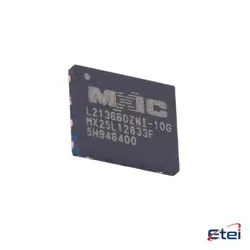
Abbildungen dienen nur als Referenz
PIC16F1789-I/ML
+StücklisteIC MCU 8BIT 28KB FLASH 44QFN
-
HerstellerMikrochip-Technologie
-
Herstellerteil #PIC16F1789-I/ML
-
Datenblatt PIC16F1789-I/ML DataSheet
-
Auf Lager4346
365 Tage Qualitätsgarantie
7*24 Stunden-Servicegarantie
90-Tage Kundendienstgarantie
Originalproduktgarantie
Spezifikationen
| Attribut | Wert |
| Series | PIC® XLP™ 16F |
| Part Status | Active |
| DigiKey Programmable | Not Verified |
| Core Processor | PIC |
| Core Size | 8-Bit |
| Speed | 32MHz |
| Connectivity | I2C, LINbus, SPI, UART/USART |
| Peripherals | Brown-out Detect/Reset, POR, PSMC, PWM, WDT |
| Number of I/O | 35 |
| Program Memory Size | 28KB (16K x 14) |
| Program Memory Type | FLASH |
| EEPROM Size | 256 x 8 |
| RAM Size | 2K x 8 |
| Voltage - Supply (Vcc/Vdd) | 2.3V ~ 5.5V |
| Data Converters | A/D 14x12b; D/A 1x8b, 3x5b |
| Oscillator Type | Internal |
| Operating Temperature | -40°C ~ 85°C (TA) |
| Mounting Type | Surface Mount |
| Supplier Device Package | 44-QFN (8x8) |
| Package / Case | 44-VQFN Exposed Pad |
| Base Product Number | PIC16F1789 |
Übersicht
Description
Key peripherals include multiple I/O ports, a 10-bit Analog-to-Digital Converter (ADC), Enhanced Universal Synchronous Asynchronous Receiver Transmitter (EUSART), and Pulse Width Modulation (PWM) modules. It also supports various communication protocols like I2C and SPI.
The microcontroller is designed for compact and efficient applications, housed in a 28-pin QFN package. It's suitable for a wide range of applications, including consumer electronics, industrial control, and sensor interfacing.
The PIC16F1789-I/ML supports development through Microchip's MPLAB X IDE and XC8 compiler, offering easy integration and programming for embedded systems. Its combination of features and flexibility makes it a versatile choice for developers looking to balance performance with power efficiency.
Equivalent
Features
Notable features include a 10-bit Analog-to-Digital Converter (ADC) with up to 12 channels, a Digital-to-Analog Converter (DAC), and several types of timers (8-bit and 16-bit), which enhance its suitability for control applications. The microcontroller integrates hardware support for capacitive touch sensing, making it ideal for human-machine interface applications. With its Enhanced Mid-Range Core architecture, the PIC16F1789 offers improved performance and reduced power consumption.
Additionally, it comes equipped with a Power-on Reset (POR), Brown-out Reset (BOR), and Watchdog Timer (WDT) for enhanced reliability and stability in various operating conditions. The device is available in a 40-pin QFN package.
Pinout
Key functions and features include:
1. CPU and Memory: It features an 8-bit CPU with a maximum operating frequency of 32 MHz, alongside Flash memory for program storage, RAM, and EEPROM for data storage.
2. I/O Ports: The device offers multiple general-purpose I/O pins, which can be used for digital input/output operations.
3. Timers: It includes multiple timers and counters supporting various timing operations.
4. Analog Features: It has an integrated ADC (Analog-to-Digital Converter) module and comparators for analog signal processing.
5. Communication Interfaces: The PIC16F1789 supports several communication protocols, including I2C, SPI, and USART, enabling connectivity and data exchange with other devices.
6. PWM: Pulse Width Modulation outputs for motor control or signal modulation.
These features make it suitable for various applications, including consumer electronics, automotive, and industrial control.
Manufacturer
Application
1. Industrial Control: Ideal for automated systems due to its capability to handle complex control algorithms.
2. Consumer Electronics: Used in devices requiring efficient power management and user interface capabilities.
3. Home Automation: Supports smart home devices with its integrated peripherals and communication modules.
4. Automotive: Suitable for non-critical applications like lighting and infotainment systems.
5. Medical Devices: Powers portable and low-power medical equipment for monitoring and diagnostics.
6. Energy Management: Applied in smart metering and energy-efficient systems thanks to its low power consumption.
Its integration of multiple peripherals and low power consumption makes it suitable for these diverse applications.