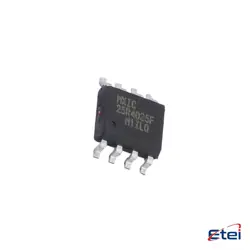
Abbildungen dienen nur als Referenz
PIC16F1937-I/ML
+StücklisteIC MCU 8BIT 14KB FLASH 44QFN
-
HerstellerMikrochip-Technologie
-
Herstellerteil #PIC16F1937-I/ML
-
Paket VQFN-44
-
Auf Lager4339
365 Tage Qualitätsgarantie
7*24 Stunden-Servicegarantie
90-Tage Kundendienstgarantie
Originalproduktgarantie
Spezifikationen
| Attribut | Wert |
| Supplier | Microchip Technology |
| Package | Tube |
| Series | PIC® XLP™ 16F |
| ProductStatus | Active |
| CoreProcessor | PIC |
| CoreSize | 8-Bit |
| Speed | 32MHz |
| Connectivity | I²C, LINbus, SPI, UART/USART |
| Peripherals | Brown-out Detect/Reset, LCD, POR, PWM, WDT |
| NumberofI/O | 36 |
| ProgramMemorySize | 14KB (8K x 14) |
| ProgramMemoryType | FLASH |
| EEPROMSize | 256 x 8 |
| RAMSize | 512 x 8 |
| Voltage-Supply(Vcc/Vdd) | 1.8V ~ 5.5V |
| DataConverters | A/D 14x10b |
| OscillatorType | Internal |
| OperatingTemperature | -40°C ~ 85°C (TA) |
| MountingType | Surface Mount |
| Package/Case | 44-VQFN Exposed Pad |
Übersicht
Description
Key points:
- On‑chip memory: Flash for program storage, RAM, and often EEPROM for data.
- Peripherals: multiple timers, analog-to-digital converter, comparators, and communication modules (USART/EUSART with SPI/I2C via MSSP), plus capture/compare/PWM as needed.
- Core and performance: 8‑bit PIC core with a compact instruction set optimized for control tasks.
- Power and clocks: operate from roughly 2.0 to 5.5 V; various clock options (internal oscillator or external crystal/ceramic resonator); sleep/idle modes for low power.
- Development: supported by MPLAB X IDE, XC8 compiler, and debugging/prototyping tools (e.g., PICkit).
Typical use: general purpose microcontroller for embedded applications in industrial, consumer, and small automation. For exact features and package options, consult the PIC16F1937 datasheet.
Equivalent
- PIC16F1936-I/ML
- PIC16F1933-I/ML
- PIC16F1934-I/ML
- PIC16F1935-I/ML
They share the same core and peripherals; pick the one that matches your memory/IO needs. Always verify with the datasheet and Microchip’s cross-reference tool for exact pinout/packaging (DIP/SOIC/MSOP).
Features
- 8-bit PIC16 core with 14-bit instruction word (Harvard architecture).
- Program memory: up to several KB Flash (device-dependent); RAM: a few hundred bytes; EEPROM: a few hundred bytes.
- Analog: 10-bit ADC with multiple channels; optional voltage reference.
- Timers and PWM: multiple timers (including CCP/PWM modules) for timing and motor control.
- Communications: EUSART (USART), MSSP module for I2C/SPI.
- Peripherals: analog comparators; various I/O management features.
- I/O: multiple GPIO pins (package-dependent).
- Low-power modes: Sleep and Idle; wake-up via interrupt; watchdog timer; Brown-out/Power-on Reset.
- Clocking: internal oscillator plus external clock/crystal options.
- Operating voltage: 2.0–5.5 V; Industrial temperature range: -40°C to +85°C.
- Development/Programming: ICSP for programming and debugging.
- Packaging: -ML suffix indicates industrial temp range in a plastic package.
Note: exact memory sizes and pin counts vary by specific package/revision; consult the datasheet for precise numbers.
Pinout
- Function: 8‑bit Microchip PIC16F microcontroller (PIC16F1937) for general embedded control; includes flash program memory, RAM, EEPROM, ADC, timers, CCP/PWM, and serial peripherals (I2C/SPI, EUSART) for interfacing and control.
Manufacturer
- What kind of company: A global semiconductor company that designs and manufactures embedded-control solutions, including PIC and other microcontrollers, analog, and memory products. Headquartered in Chandler, Arizona, USA; founded in 1989 and known for acquiring Atmel in 2016.
Application
- Consumer/home appliances (thermostats, remote controls, small displays)
- Industrial and automotive sensing and small control tasks (industrial temperature range)
- Battery-powered portable devices and wearables (low‑power modes)
- Sensor interfacing and data acquisition (multiple ADC channels, comparators)
- Simple motor control for small DC motors, steppers, fans
- Embedded control with serial interfaces (I2C, SPI, USART) and basic peripherals