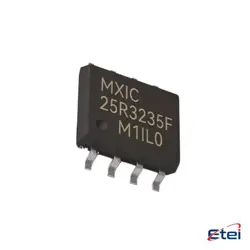
Abbildungen dienen nur als Referenz
PIC18F4580-I/PT
+StücklisteIC MCU 8BIT 32KB FLASH 44TQFP
-
HerstellerMikrochip-Technologie
-
Herstellerteil #PIC18F4580-I/PT
-
Paket TQFP-44
-
Auf Lager1239
365 Tage Qualitätsgarantie
7*24 Stunden-Servicegarantie
90-Tage Kundendienstgarantie
Originalproduktgarantie
Spezifikationen
| Attribut | Wert |
| Package | Tray |
| Series | PIC® 18F |
| ProductStatus | Active |
| CoreProcessor | PIC |
| CoreSize | 8-Bit |
| Speed | 40MHz |
| Connectivity | CANbus, I²C, SPI, UART/USART |
| Peripherals | Brown-out Detect/Reset, HLVD, POR, PWM, WDT |
| NumberofI/O | 36 |
| ProgramMemorySize | 32KB (16K x 16) |
| ProgramMemoryType | FLASH |
| EEPROMSize | 256 x 8 |
| RAMSize | 1.5K x 8 |
| Voltage-Supply(Vcc/Vdd) | 4.2V ~ 5.5V |
| DataConverters | A/D 11x10b |
| OscillatorType | Internal |
| OperatingTemperature | -40°C ~ 85°C (TA) |
| MountingType | Surface Mount |
| Package/Case | 44-TQFP |
Übersicht
Description
Notable features of the PIC18F4580 include an Enhanced CAN module for automotive networking, multiple I/O ports, and various communication interfaces such as SPI, I2C, and USART. It also supports advanced features like Enhanced Capture/Compare/PWM (ECCP) modules, 10-bit ADC with up to 13 channels, and a range of timers for precise control applications.
Packaged in a TQFP-44 (Thin Quad Flat Pack), the microcontroller is designed for surface mounting, making it suitable for compact applications. Its low-power consumption and extensive feature set make it a versatile choice for embedded systems development.
Equivalent
1. PIC18F458-I/PT: Similar family with slightly different specifications.
2. PIC18F4680: Offers more memory and similar features.
3. PIC18F4585: Provides CAN capability and similar performance.
4. Microchip PIC18F25K80: Offers similar functionalities with additional features and lower power consumption.
5. Atmel ATmega16: Comparable in terms of memory and performance in some applications.
Ensure compatibility by checking specific application requirements and features.
Features
1. Processing Power: It has an 8-bit CPU with up to 10 MIPS operation at 40 MHz.
2. Memory: 32 KB of Flash program memory, 1536 bytes of RAM, and 256 bytes of EEPROM.
3. Peripherals: Includes a 10-bit A/D converter with up to 13 channels, Enhanced Capture/Compare/PWM (ECCP) modules, and two comparators.
4. Communication Interfaces: Supports CAN 2.0B for robust data transfer, along with SPI, I2C, and EUSART modules for versatile connectivity.
5. Operating Voltage: Operates in a wide voltage range from 4.2V to 5.5V.
6. Package: Offered in a 44-pin TQFP package.
7. Special Features: Includes nanoWatt technology for low-power operation and an extended instruction set for increased efficiency.
The PIC18F4580 is well-suited for automotive, industrial control, and networked applications due to its robust feature set and communication capabilities.
Pinout
Key features and functions of the pins include:
1. I/O Ports: The microcontroller has multiple I/O ports, which can be used for digital input and output.
2. Analog Inputs: It includes several analog input channels for the integrated 10-bit Analog-to-Digital Converter (ADC).
3. USART: There are pins for the Universal Synchronous Asynchronous Receiver Transmitter to facilitate serial communication.
4. SPI/I2C: The device supports both SPI and I2C communication protocols, utilizing designated pins for these functions.
5. PWM: The microcontroller can generate Pulse Width Modulation signals, useful for controlling devices like motors.
6. CAN Module: Unique to the PIC18F4580 is its support for the CAN bus protocol, utilizing a dedicated set of pins for communication.
These features make the PIC18F4580-I/PT suitable for a wide range of applications, including automotive, industrial, and embedded systems.
Manufacturer
Application
1. Automotive Systems: Used in engine control, dashboard instrumentation, and body electronics.
2. Industrial Automation: Facilitates process control and automation tasks.
3. Consumer Electronics: Powers devices like home appliances and entertainment systems.
4. Communication Systems: Supports CAN (Controller Area Network) communication, useful in networked control systems.
5. IoT Devices: Helps in creating intelligent and connected devices.
6. Embedded Control Systems: Utilized in custom embedded solutions requiring robust processing and control capabilities.
Its enhanced flash memory, extensive I/O options, and peripheral features make it suitable for these applications.