
Beginner’s Guide to Capacitors
Nov 13, 2025
Introduction
Capacitors are tiny but powerful parts that are found in many common devices. They help circuits work well and motors start up quickly by storing and releasing electrical energy. Capacitors are very important for things like air conditioners, fans, computers, and cameras. This guide for beginners tells you what they are, how they work, what kinds there are, and where you can find them.
What Is a Capacitor?

Capacitors are one of the most common but least understood parts of electronics. To someone who doesn't know much about electronics, they might look like small cylinders, discs, or even flat chips soldered onto a circuit board. But their job is much more important than their size suggests. In a circuit, a capacitor is a device that stores and releases electrical energy. A capacitor is different from a battery in that it charges quickly and then releases its energy in short bursts when needed. A battery, on the other hand, provides a steady flow of power over time.
A Simple Definition
A capacitor is made up of two conductive plates that are separated by a dielectric, which is a material that doesn't conduct electricity. When voltage is applied, one plate gets a positive charge and the other gets a negative charge. The dielectric keeps the charges from touching, which makes an electric field between the plates. You can then quickly release this stored energy back into the circuit.
Everyday Analogy
To help you picture this better, think of a capacitor as a bucket of water:
-
- When you put the bucket under a faucet (charging), it fills up quickly.
-
- The water pours out quickly when the container is tipped (discharging).
-
- You can fill and empty the bucket over and over again.
Capacitors are very useful in electronics because they can charge and discharge over and over again.
Capacitors in Daily Life
You probably used a device that uses capacitors even if you've never seen one. For instance, a camera's flash charges up in a capacitor before letting out all its energy in a bright flash.
A capacitor gives a ceiling fan's motor the extra push it needs to start spinning.
Capacitors help keep voltage stable in computers so that sensitive parts don't get hurt when there are sudden drops or spikes.
Capacitors vs. Batteries
While both store energy, they do so in very different ways. Here’s a quick comparison:
| Feature | Capacitor | Battery |
|---|---|---|
| Storage Method | Electric field | Chemical reaction |
| Charge/Discharge | Very fast | Slower |
| Energy Capacity | Small | Large |
| Best Use | Short bursts, smoothing, starting | Long-term power supply |
| Lifespan | Millions of cycles | Limited charge/discharge cycles |
This shows why capacitors are not meant to replace batteries but to work alongside them.
Why They Matter
Capacitors are small, but they are very important for:
-
- Keeping voltage stable in power supplies.
-
- Helping motors in things like refrigerators and air conditioners get started.
-
- Giving cameras and other devices short bursts of energy.
-
- Keeping electronics safe from sudden changes in power.
Many devices wouldn't start, run smoothly, or shut down when they weren't supposed to without capacitors.
Key Takeaways
-
- A capacitor is a device that stores energy and can quickly charge and discharge.
-
- Two plates are separated by a dielectric material to make it.
-
- Capacitors are not batteries, but they work with them in circuits.
-
- They are important parts of everyday things like fans, cameras, computers, and air conditioners.
How Do Capacitors Work?
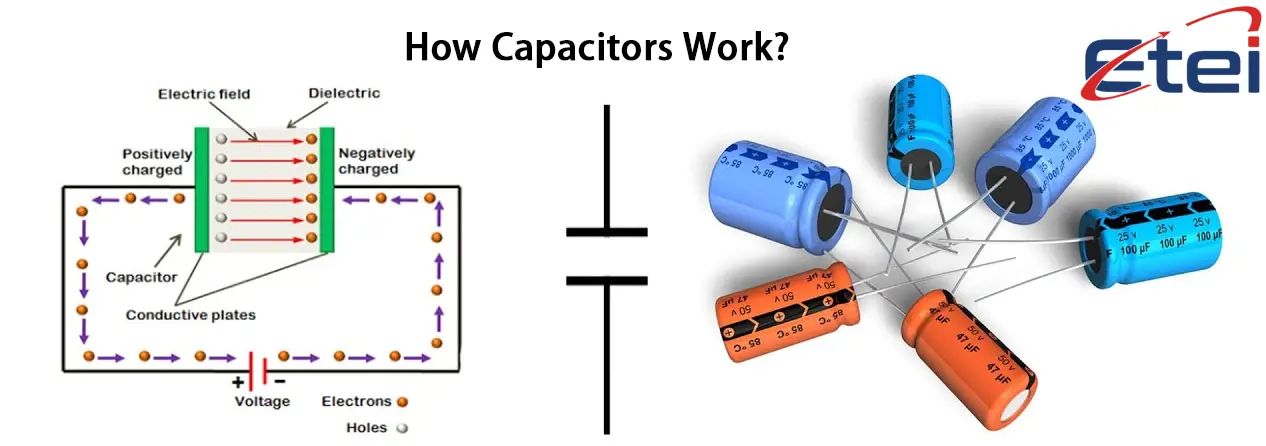
Now that we know what a capacitor is, let's look more closely at how it works in a circuit. This part will talk about how energy is stored and released, what the dielectric does, and how these things affect how things work in the real world.
The Core Mechanism
Two conductive plates are separated by an insulating material called the dielectric at the center of every capacitor. When a voltage source is put across the plates, electrons are pushed onto one plate, making it negatively charged, and the other plate loses electrons, making it positively charged. The dielectric stops the charges from moving directly between the plates. Instead, the electric field between them stores the energy.
When the circuit needs power, the capacitor lets the stored electrons flow back into the system. This process happens almost right away, which is why capacitors are so good at giving short bursts of power.
Charging and Discharging in Action
The operation of a capacitor can be broken down into two repeating steps:
-
- Charging – The capacitor fills with electrical energy when connected to a power source.
-
- Discharging – The capacitor releases that energy back into the circuit when needed.
This cycle can occur millions of times without significant wear, making capacitors extremely durable compared to many other components.
A Beginner-Friendly Analogy
Think of a capacitor as a spring:
-
- When you press down on the spring, it stores potential energy (charging).
-
- When you release it, the spring bounces back, releasing that energy (discharging).
This analogy helps explain why capacitors are so useful in circuits that need quick, repeatable bursts of energy.
Time Constant and Speed
The speed of capacitors is one of the most important things about how they work. They can charge and discharge almost instantly because they don't depend on chemical reactions. Engineers often use the term "time constant" (τ) to explain this behavior. A time constant is the product of resistance (R) and capacitance (C) in a circuit.
time constant = resistance * capacitance
This number tells us how fast a capacitor can charge or discharge. A small time constant means that the capacitor charges and discharges quickly, while a big one means that it does so more slowly.
Real-World Examples of Operation
-
- Camera Flash: The capacitor charges from the battery, then discharges all at once to create a bright flash of light.
-
- Power Supply Smoothing: Capacitors absorb small fluctuations in voltage and release energy to keep the output steady.
-
- Motor Starting: In appliances like air conditioners, capacitors provide the initial surge of energy needed to start the motor.
Why Capacitors Are Reliable
People like capacitors not only because they are fast, but also because they last a long time. They can go through millions of charge and discharge cycles without wearing out because they don't depend on chemical changes. Because of this, they are perfect for places where dependability is very important, like computers, medical devices, and industrial machines.
Key Takeaways
-
- Capacitors hold energy in an electric field that is between two plates.
-
- When you connect them to a power source, they charge, and when the circuit needs energy, they discharge.
-
- Their main benefit is speed; they respond almost right away, unlike batteries.
-
- They can do this cycle millions of times, which makes them very reliable.
How Capacitors Work
| Concept | Explanation |
|---|---|
| Structure | Two plates separated by a dielectric |
| Charging | Stores energy when voltage is applied |
| Discharging | Releases energy back into the circuit quickly |
| Analogy | Like a spring storing and releasing energy |
| Speed | Almost instantaneous response |
| Durability | Millions of charge/discharge cycles |
Types of Capacitors

Now that we've talked about what capacitors are and how they work, let's look at the different kinds you might come across. There are many different types of capacitors, and each one is made for a different job. The materials they are made of, their size, and how they deal with voltage and capacitance are what make them different. Learning about these types helps beginners understand why one capacitor is used instead of another in real life.
Ceramic Capacitors
-
- Description: Small, cheap, and used by a lot of people.
-
- Material: It is made of ceramic dielectric.
-
- Use: Commonly used in circuit boards to filter and stabilize signals.
-
- Pros: It works well, doesn't cost much, and comes in very small sizes.
-
- Limitations: Compared to other types, the capacitance values are low.
Electrolytic Capacitors
-
- Description: These are bigger cylindrical capacitors that are often found in power supplies.
-
- Material: An electrolyte should be part of the dielectric.
-
- Use: Give higher capacitance values, which is great for smoothing out voltage in power circuits.
-
- Strengths: A lot of capacitance in a small space.
-
- Disadvantages: They are polarized (they have to be connected the right way) and don't last as long.
Film Capacitors
-
- Use a thin plastic film as the dielectric.
-
- Use: Used in audio equipment, motor circuits, and other situations where stability is important.
-
- Strengths: It lasts a long time, is very stable, and is not polarized.
-
- Limitations: They are bigger than ceramic or electrolytic types.
Supercapacitors
-
- Also known as ultracapacitors, these are made for very high capacitance.
-
- Use: Give renewable energy systems, electric cars, or memory backup quick bursts of power.
-
- Strengths: Can hold a lot more energy than regular capacitors.
-
- Disadvantages: lower voltage ratings and can't be used instead of batteries.
AC Capacitors (Special Category)
-
- Description: Made just for systems that use alternating current.
-
- Use: Found in refrigerators, air conditioners, and other appliances with motors.
-
- Pros: Give motors the extra power they need to start and run smoothly.
-
- Limitations: Must be carefully matched to the appliance's specs.
Common Capacitor Types
| Type | Dielectric Material | Typical Use | Strengths | Limitations |
|---|---|---|---|---|
| Ceramic | Ceramic | Filtering, signal stabilization | Small, cheap, reliable | Limited capacitance |
| Electrolytic | Electrolyte | Power supplies, smoothing voltage | High capacitance, compact | Polarized, shorter lifespan |
| Film | Plastic film | Audio, motors, stable circuits | Very stable, long life, non-polar | Larger size |
| Supercapacitor | Advanced materials | Energy storage, quick bursts | Very high capacitance | Low voltage, bulky |
| AC Capacitor | Varies | Air conditioners, appliances | Motor starting/running support | Must match appliance specs |
Why Knowing the Types Matters
Every kind of capacitor has its own pros and cons. It depends on the job which one is best:
-
- A ceramic capacitor could help your phone's signals stay stable.
-
- An electrolytic capacitor could help your computer's power run more smoothly.
-
- A film capacitor could help your sound system sound clear.
-
- An AC capacitor makes sure that your air conditioner always starts up.
By knowing about these differences, beginners can better understand why capacitors are everywhere and why one type can't do everything.
Applications of Capacitors
You should now know what capacitors are, how they work, and the different types that are available. The next step is to find out where they are really used. Capacitors aren't just parts of a circuit diagram; they are useful tools that make modern life possible. They have many important uses, from household appliances to cutting-edge technology.
Power Supply Stabilization
Power supplies are one of the most common places to find capacitors. The electricity that comes from the grid isn't always steady; it can change. Capacitors work like shock absorbers to smooth out these changes so that sensitive electronics like computers, TVs, and medical devices get steady power. Without them, devices would blink, reset, or even stop working.
Motor Starting and Running
Capacitors give the motor in appliances with motors, like air conditioners, refrigerators, and washing machines, the first burst of energy it needs to start. Some capacitors make sure the motor runs smoothly and efficiently after it starts. This is why an air conditioner with a broken capacitor won't start or will only blow warm air.
Signal Processing in Electronics
Capacitors are also used to clean up signals. In radios, TVs, and audio systems, they help separate signals, block noise that isn't needed, and let only the right frequencies through. This is why the music you like sounds clear instead of fuzzy and full of noise.
Timing Circuits
Capacitors are used in timing circuits because they can charge and discharge at a steady rate. For example, in blinking LED lights or delay circuits, the capacitor controls how long the light stays on or off. This idea is also used in oscillators, which make signals that repeat for clocks and communication systems.
Energy Storage for Quick Bursts
Some devices need a quick burst of energy that a battery can't give them on its own. Capacitors do this job very well. A good example of this is the camera flash. The battery slowly charges the capacitor, which then releases all of its energy at once to make a bright flash of light.
Renewable Energy Systems
Capacitors help solar panels and wind turbines control the flow of electricity, which isn't always even. Capacitors make the power from renewable sources more stable so that homes and businesses can use it.
Automotive Applications
Capacitors are a very important part of modern cars. They help ignition systems, keep the voltage steady in car electronics, and even give hybrid and electric cars bursts of energy. Sometimes, supercapacitors hold energy when you brake and let it go when you speed up.
Medical Equipment
Capacitors are very important in medical technology. For instance, defibrillators use capacitors to store energy and then release it in a controlled shock to get a patient's heart going again. Capacitors are essential in life-saving equipment because they are fast and reliable.
Communication Systems
Capacitors are also very important in devices that let people talk to each other. They help tune radio frequencies, keep signals stable in cell towers, and make sure that data transmission stays clear and uninterrupted. Without them, wireless communication would not be as reliable.
Applications of Capacitors
| Application Area | Role of Capacitor | Example Device/Use Case |
|---|---|---|
| Power Supply | Smooths voltage fluctuations | Computers, TVs, chargers |
| Motor Starting | Provides surge energy to start motors | Air conditioners, refrigerators |
| Signal Processing | Filters and separates signals | Radios, audio systems |
| Timing Circuits | Controls charge/discharge timing | LED blinkers, oscillators |
| Energy Storage | Provides quick bursts of energy | Camera flash, toys |
| Renewable Energy | Stabilizes irregular power | Solar panels, wind turbines |
| Automotive | Supports ignition, energy recovery | Cars, hybrids, EVs |
| Medical Equipment | Stores and releases controlled shocks | Defibrillators |
| Communication Systems | Stabilizes and tunes signals | Radios, cell towers, satellites |
Why Applications Matter
Beginners can better understand how important capacitors are by knowing where they are used. They are not just ideas; they are real parts that make modern technology work. Capacitors are everywhere, from keeping your lights on to saving lives in hospitals.
How to Read Capacitor Labels
It can be hard to read capacitor labels at first because they have strange numbers, tiny letters, and symbols that don't seem to mean anything. Once you understand how the system works, these markings are a great way to find, choose, and use capacitors safely in real-life projects. If you want to fix something, make a DIY circuit, or sort parts in a workshop, you need to know how to read capacitor labels.
Capacitance Codes: Decoding the Numbers
A three-digit code on most small capacitors, especially ceramic ones, tells you how much capacitance they have in picofarads (pF).
-
- The base number is the first two digits.
-
- The third digit is the number of zeros to add to the number.
Example:
-
- 104
-
- The first two numbers are 10.
-
- Third digit: 4, so add four zeros
-
- 100,000 pF = 100 nF = 0.1 µF
Common Capacitance Codes
| Code | Capacitance (pF) | Equivalent |
|---|---|---|
| 101 | 100 | 0.0001 μF |
| 102 | 1,000 | 0.001 μF |
| 103 | 10,000 | 0.01 μF |
| 104 | 100,000 | 0.1 μF |
| 105 | 1,000,000 | 1 μF |
How to Read Capacitor Labels
| Label Element | Meaning | Example |
|---|---|---|
| Capacitance Code | Value in pF (3-digit format) | 104 = 0.1 μF |
| Voltage Rating | Max voltage the capacitor can handle | 50V, 250V |
| Polarity Indicator | Shows positive/negative terminals | Stripe, + sign |
| Tolerance Code | Accuracy of capacitance | K = ±10% |
| Temperature Rating | Operating temperature range | −40°C to +85°C |
| Physical Format | Shape and lead orientation | Radial, Axial |
Conclusion
Capacitors are small, but they have a huge effect on modern technology. They are the quiet workhorses of electronics, from powering the flash in a camera to getting an air conditioner going. By now, you know how capacitors hold and release energy, the different kinds that are out there, and the many ways they are used in everyday life.
The most important thing for beginners to remember is that capacitors aren't hard to understand once you break them down. They're just short-term energy banks that keep circuits stable and reliable. Capacitors make sure that electricity flows smoothly and that devices work as they should in appliances, cars, renewable energy systems, and medical equipment.
As you learn more about electronics, keep in mind that capacitors are everywhere, even if you can't see them. The first step to appreciating the hidden parts that make our modern world possible is to understand them.
FAQs
How long does a capacitor last?
Ceramic and film capacitors can last for decades, while electrolytic ones usually only last 5 to 15 years.
How do I know if a capacitor is bad?
A bad capacitor can make motors not start, devices flicker, or bulge and leak.
What’s the difference between AC and DC capacitors?
AC capacitors are used in appliances that use alternating current, and DC capacitors are used in electronic circuits.
Can I replace a capacitor myself?
You can replace small electronic capacitors if you know how to solder, but professionals should handle appliance capacitors.
Why do capacitors fail?
They fail mainly due to heat, overvoltage, or natural aging of their materials.
Are capacitors rechargeable?
Yes, they naturally charge and discharge repeatedly as part of their function.
Vorheriger BeitragBeginner’s Guide to the 18650 Battery: Power, Performance, and Practical Use
Nächster BeitragMicrocontroller (MCU) Guide: Architecture, Programming, Industrial Use, and Troubleshooting
Ähnliche
Flip-flops are digital circuits that sto..

Sensors detect changes in the environmen..
Oscillators are circuits that generate r..

Thermopiles are sensors that convert hea..

CR123 and CR123A batteries are the same ..

The L1154F is an alkaline button cell, s..
HOT

Telephone cables (RJ11) connect landline..

AG10 battery equivalents include 189, LR..

Battery testers check battery health by ..

Switch poles control how many circuits a..

Learn how to strip a wire safely and eff..