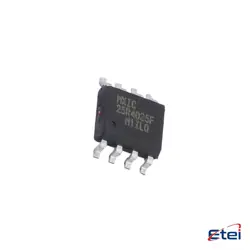
Abbildungen dienen nur als Referenz
AT25320B-XPD-T
+StücklisteEEPROM
-
HerstellerMikrochip-Technologie
-
Herstellerteil #AT25320B-XPD-T
-
Auf Lager23216
365 Tage Qualitätsgarantie
7*24 Stunden-Servicegarantie
90-Tage Kundendienstgarantie
Originalproduktgarantie
Spezifikationen
| Attribut | Wert |
Übersicht
Description
The AT25320B-XPD-T is part of the AT25 series of serial EEPROM (Electrically Erasable Programmable Read-Only Memory) devices. These EEPROMs are commonly used for storing small amounts of non-volatile data. The "320" in the model number typically refers to 32Kb (kilobits) of storage capacity.
Key features of the AT25320B-XPD-T include:
1. Interface: Utilizes an SPI (Serial Peripheral Interface) for communication, which allows for high-speed data transfer and is compatible with a wide range of microcontrollers.
2. Package: The "XPD" in the part number might indicate a specific package type suitable for surface mounting, often designed for compact electronic applications.
3. Endurance: Offers high endurance and data retention capabilities, essential for reliable long-term storage.
4. Low Power Consumption: Designed to operate with minimal power, making it ideal for battery-powered devices.
5. Security Features: May include write protection mechanisms to prevent accidental data corruption.
This EEPROM is typically used in applications requiring frequent updates to stored data, such as configuration settings, user preferences, or small logs.
Key features of the AT25320B-XPD-T include:
1. Interface: Utilizes an SPI (Serial Peripheral Interface) for communication, which allows for high-speed data transfer and is compatible with a wide range of microcontrollers.
2. Package: The "XPD" in the part number might indicate a specific package type suitable for surface mounting, often designed for compact electronic applications.
3. Endurance: Offers high endurance and data retention capabilities, essential for reliable long-term storage.
4. Low Power Consumption: Designed to operate with minimal power, making it ideal for battery-powered devices.
5. Security Features: May include write protection mechanisms to prevent accidental data corruption.
This EEPROM is typically used in applications requiring frequent updates to stored data, such as configuration settings, user preferences, or small logs.
Equivalent
The AT25320B-XPD-T is a 32Kb SPI Serial EEPROM. Equivalent products from other manufacturers may include the Microchip 25LC320A, the STMicroelectronics M95640, and the Rohm BR25H032. These chips typically offer similar features such as SPI interface, non-volatile memory, and similar storage capacity. Always verify pin configuration and specific electrical characteristics to ensure compatibility.
Features
The AT25320B-XPD-T is a memory chip that features a 32Kb (kilobit) capacity organized as 4096 x 8 bits. It utilizes a Serial Peripheral Interface (SPI) for communication, which supports up to 20 MHz clock rates for high-speed data transfer. The chip operates at a voltage range of 1.7V to 5.5V, making it suitable for various applications, including battery-operated devices. It offers low-power consumption, with standby and active modes to enhance energy efficiency. The device includes a hardware write-protect pin to ensure data security and prevent inadvertent writes. Designed for reliability, the AT25320B-XPD-T features an endurance of 1,000,000 write cycles and data retention of up to 100 years. It comes in an 8-lead PDIP, SOIC, or TSSOP package, providing flexibility for integration into different circuit designs. These features make it ideal for use in applications requiring robust and reliable non-volatile memory storage.
Pinout
The AT25320B-XPD-T is an 8-pin Serial EEPROM device from Microchip Technology. Here is a concise description of the pin count and functions:
1. CS (Chip Select): This pin enables the device when it is set to low and disables it when set to high.
2. SO (Serial Data Output): Outputs data from the EEPROM to the microcontroller.
3. WP (Write Protect): Protects against inadvertent write operations when set to high.
4. GND (Ground): Ground reference for the device.
5. SI (Serial Data Input): Inputs data from the microcontroller to the EEPROM.
6. SCK (Serial Clock): Provides the clock signal for the SPI communication.
7. HOLD: Pauses the device operations when set to low.
8. VCC (Power Supply): Supplies the power to the device.
This configuration supports SPI (Serial Peripheral Interface) communication, facilitating data transfer between the EEPROM and a microcontroller.
1. CS (Chip Select): This pin enables the device when it is set to low and disables it when set to high.
2. SO (Serial Data Output): Outputs data from the EEPROM to the microcontroller.
3. WP (Write Protect): Protects against inadvertent write operations when set to high.
4. GND (Ground): Ground reference for the device.
5. SI (Serial Data Input): Inputs data from the microcontroller to the EEPROM.
6. SCK (Serial Clock): Provides the clock signal for the SPI communication.
7. HOLD: Pauses the device operations when set to low.
8. VCC (Power Supply): Supplies the power to the device.
This configuration supports SPI (Serial Peripheral Interface) communication, facilitating data transfer between the EEPROM and a microcontroller.
Manufacturer
The AT25320B-XPD-T is manufactured by Microchip Technology Inc. Microchip Technology is a leading American company specializing in the production of microcontrollers, memory, and analog and interface products. They serve various industries, including automotive, aerospace, consumer electronics, and industrial automation. The company is known for providing comprehensive semiconductor solutions and has a reputation for delivering reliable and high-performance products.
Application
The AT25320B-XPD-T is a serial EEPROM typically used in applications requiring non-volatile memory storage. Key application areas include:
1. Consumer Electronics: Used for storing user settings, configuration data, and calibration parameters.
2. Industrial Control Systems: Provides reliable data retention for various industrial automation tasks.
3. Automotive Systems: Stores critical data such as configuration settings and diagnostic information.
4. Medical Devices: Utilized for maintaining non-volatile data in medical equipment.
5. Communication Systems: Stores configuration and network parameters.
6. Security Systems: Holds secure access codes and system settings.
Its compact size and low power consumption make it versatile for embedded systems across various sectors.
1. Consumer Electronics: Used for storing user settings, configuration data, and calibration parameters.
2. Industrial Control Systems: Provides reliable data retention for various industrial automation tasks.
3. Automotive Systems: Stores critical data such as configuration settings and diagnostic information.
4. Medical Devices: Utilized for maintaining non-volatile data in medical equipment.
5. Communication Systems: Stores configuration and network parameters.
6. Security Systems: Holds secure access codes and system settings.
Its compact size and low power consumption make it versatile for embedded systems across various sectors.
Package
The AT25320B-XPD-T is typically available in an 8-lead PDIP (Plastic Dual In-line Package) form factor.