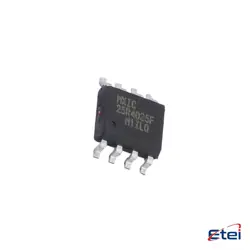
Abbildungen dienen nur als Referenz
PIC16F18877-I/PT
+StücklisteIC MCU 8BIT 56KB FLASH 44TQFP
-
HerstellerMikrochip-Technologie
-
Herstellerteil #PIC16F18877-I/PT
-
Datenblatt PIC16F18877-I/PT DataSheet
-
Paket TQFP-44
-
Auf Lager6420
365 Tage Qualitätsgarantie
7*24 Stunden-Servicegarantie
90-Tage Kundendienstgarantie
Originalproduktgarantie
Spezifikationen
| Attribut | Wert |
| Package / Case | Tray |
| Series | PIC® XLP™ 16F, Functional Safety (FuSa) |
| Part Status | Active |
| Core Processor | PIC |
| Core Size | 8-Bit |
| Speed | 32MHz |
| Connectivity | I²C, LINbus, SPI, UART/USART |
| Peripherals | Brown-out Detect/Reset, POR, PWM, WDT |
| Number of I/O | 36 |
| Program Memory Size | 56KB (32K x 14) |
| Program Memory Type | FLASH |
| EEPROM Size | 256 x 8 |
| RAM Size | 4K x 8 |
| Voltage - Supply (Vcc/Vdd) | 2.3V ~ 5.5V |
| Data Converters | A/D 35x10b; D/A 1x5b |
| Oscillator Type | Internal |
| Operating Temperature | -40°C ~ 85°C (TA) |
| Mounting Type | Surface Mount |
Übersicht
Description
The PIC16F18877-I/PT offers a range of peripherals, including up to 35 I/O pins, multiple timers, and enhanced communication interfaces such as UART, SPI, and I2C, making it suitable for various embedded applications. It includes advanced features like a 10-bit ADC, PWM outputs, and a Capture/Compare/PWM (CCP) module.
This microcontroller is designed for low-power applications, with features like nanoWatt XLP technology to reduce power consumption during operation and sleep modes. It is packaged in a 44-pin TQFP, supporting easy integration into circuit designs. The PIC16F18877-I/PT is ideal for applications requiring moderate processing power, flexibility, and low power consumption.
Equivalent
Features
1. Core: It uses an enhanced mid-range core with up to 49 instructions.
2. Memory: It offers 14 KB of Flash program memory, 1 KB of SRAM, and 256 bytes of EEPROM.
3. Operating Voltage: The controller operates between 1.8V and 5.5V.
4. I/O Ports: It has 35 I/O pins, offering flexibility for various applications.
5. Peripherals: Includes multiple timers, an Enhanced Universal Synchronous Asynchronous Receiver Transmitter (EUSART), Master Synchronous Serial Port (MSSP) module supporting I2C and SPI, and a 12-bit Analog-to-Digital Converter (ADC).
6. Special Features: Features like Configurable Logic Cell (CLC), Complementary Waveform Generator (CWG), and a Digital Signal Modulator (DSM) enhance its functionality.
7. Communication Interfaces: Incorporates support for I2C, SPI, and EUSART for versatile communication.
8. Temperature Range: It operates within an industrial temperature range of -40°C to 85°C.
9. Package: Available in a 44-pin TQFP package.
These features make the PIC16F18877-I/PT suitable for a broad range of applications, from simple to complex embedded systems.
Pinout
1. I/O Pins: The microcontroller has a number of general-purpose input/output pins that can be configured for digital or analog input/output.
2. Analog Inputs: It features multiple analog-to-digital converter (ADC) channels, allowing it to interface with analog sensors.
3. PWM Outputs: It has Pulse Width Modulation (PWM) capabilities, useful for controlling motors and other devices.
4. Communication Interfaces: It supports various communication protocols including I2C, SPI, and USART for serial communication.
5. Power and Ground Pins: These provide the necessary power supply and grounding for the microcontroller.
6. Oscillator Pins: Pins for connecting an external oscillator or crystal for clock generation.
7. Timer/Counter Functions: Pins are available for timer and counter operations.
8. Special Function Pins: Includes pins for reset, interrupt, and other specialized functions.
Overall, the PIC16F18877-I/PT is versatile for various applications, from simple control tasks to more complex embedded system projects.
Manufacturer
Application
1. Embedded Systems: Ideal for small to medium-sized embedded projects due to its compact design.
2. IoT Devices: Supports connectivity features, making it useful for Internet of Things applications.
3. Consumer Electronics: Utilized in devices requiring efficient power management and robust interfacing.
4. Industrial Automation: Suitable for control systems, sensors, and data acquisition tasks.
5. Home Automation: Powers smart home devices like thermostats and lighting controls.
6. Automotive: Used in non-critical automotive applications for monitoring and control.
7. Educational Projects: Its simplicity and ease of use make it excellent for learning and prototyping.