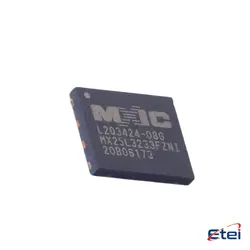
Abbildungen dienen nur als Referenz
PIC16F648A-I/P
+StücklisteIC MCU 8BIT 7KB FLASH 18DIP
-
HerstellerMikrochip-Technologie
-
Herstellerteil #PIC16F648A-I/P
-
Datenblatt PIC16F648A-I/P DataSheet
-
Auf Lager8488
365 Tage Qualitätsgarantie
7*24 Stunden-Servicegarantie
90-Tage Kundendienstgarantie
Originalproduktgarantie
Spezifikationen
| Attribut | Wert |
| Series | PIC® 16F |
| Part Status | Active |
| Digi Key Programmable | Verified |
| Core Processor | PIC |
| Core Size | 8-Bit |
| Speed | 20MHz |
| Connectivity | UART/USART |
| Peripherals | Brown-out Detect/Reset, POR, PWM, WDT |
| Number of I/O | 16 |
| Program Memory Size | 7KB (4K x 14) |
| Program Memory Type | FLASH |
| EEPROM Size | 256 x 8 |
| RAM Size | 256 x 8 |
| Voltage - Supply (Vcc/Vdd) | 3V ~ 5.5V |
| Oscillator Type | Internal |
| Operating Temperature | -40°C ~ 85°C (TA) |
| Mounting Type | Through Hole |
| Supplier Device Package | 18-PDIP |
| Package / Case | 18-DIP (0.300", 7.62mm) |
| Base Product Number | PIC16F648 |
Übersicht
Description
1. Architecture: It uses a RISC architecture with a Harvard structure, facilitating efficient instruction execution.
2. Performance: Operating at up to 20 MHz, it provides quick processing for various applications.
3. Memory: The microcontroller includes 4 KB of Flash memory, 256 bytes of EEPROM, and 256 bytes of RAM.
4. I/O Ports: It has 16 I/O pins, allowing for flexible connectivity with external devices.
5. Peripherals: Built-in peripherals include a USART for serial communication, a comparator, an internal oscillator, and timers.
6. Low Power Consumption: Suitable for battery-powered applications due to its low power consumption modes.
7. Versatility: It supports various programming and debugging tools provided by Microchip, such as the MPLAB environment.
The PIC16F648A-I/P is ideal for applications in consumer electronics, industrial automation, and other areas requiring reliable and efficient microcontroller solutions.
Equivalent
Features
1. CPU Architecture: Harvard architecture with RISC-based instruction set, offering efficient processing capabilities.
2. Memory: Integrated with 4KB of Flash program memory, 256 bytes of EEPROM, and 256 bytes of data SRAM.
3. I/O Ports: Equipped with 16 I/O pins allowing flexible connectivity options.
4. Oscillator: Supports internal and external oscillators, with frequencies up to 20 MHz.
5. Timers: Includes two 8-bit timers (Timer0 and Timer2) and one 16-bit Timer1.
6. Capture/Compare/PWM Module: Features a CCP module for precise timing and waveform generation.
7. Serial Communication: Incorporates a USART module for asynchronous and synchronous serial communication.
8. Analog Features: Includes a comparator module but lacks an ADC, suitable for interfacing with external analog circuits.
9. Watchdog Timer: Offers a built-in watchdog timer for system reliability.
10. Power-Saving Modes: Supports multiple power-saving modes to enhance energy efficiency.
These features make the PIC16F648A-I/P suitable for a variety of low-cost embedded applications.
Pinout
1. VDD: Power supply voltage.
2. VSS: Ground.
3. RA0/AN0: Digital I/O or Analog input.
4. RA1/AN1: Digital I/O or Analog input.
5. RA2/AN2/VREF: Digital I/O, Analog input, or Voltage reference.
6. RA3/AN3/!MCLR: Digital I/O, Analog input, or Master Clear (active low).
7. RA4/T0CKI: Digital I/O or Timer0 clock input.
8. RA5/AN4: Digital I/O or Analog input.
9. RB0/INT: Digital I/O or External interrupt input.
10. RB1: Digital I/O.
11. RB2: Digital I/O.
12. RB3/PGM: Digital I/O or Low-voltage programming.
13. RB4: Digital I/O.
14. RB5: Digital I/O.
15. RB6/PGC: Digital I/O or Programming Clock.
16. RB7/PGD: Digital I/O or Programming Data.
17. RC0: Digital I/O.
18. RC1: Digital I/O.
This microcontroller supports a variety of functions through its versatile pin configuration, allowing for digital input/output, analog inputs, and specialized functions like programming and interrupt handling.
Manufacturer
Application
1. Embedded Systems: Ideal for controlling small devices and systems, such as appliances, tools, and toys.
2. Industrial Automation: Used for process control, data acquisition, and control systems.
3. Consumer Electronics: Suitable for remote controls, timers, and other household electronics.
4. Automotive: Employed in non-critical systems like lighting control and infotainment.
5. Communication Systems: Utilized in simple communication protocols and signaling.
6. Prototyping and Education: Often used in educational settings for teaching microcontroller basics and DIY projects.
Its 8-bit architecture, ease of programming, and cost-effectiveness make it suitable for a wide range of applications.