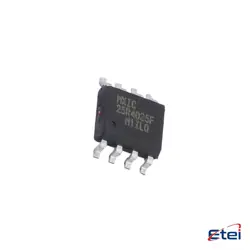
Abbildungen dienen nur als Referenz
PIC16LF1824-I/ML
+StücklisteIC MCU 8BIT 7KB FLASH 16QFN
-
HerstellerMikrochip-Technologie
-
Herstellerteil #PIC16LF1824-I/ML
-
Auf Lager5045
365 Tage Qualitätsgarantie
7*24 Stunden-Servicegarantie
90-Tage Kundendienstgarantie
Originalproduktgarantie
Spezifikationen
| Attribut | Wert |
| Series | PIC® XLP™ mTouch™ 16F |
| Part Status | Active |
| Digi Key Programmable | Not Verified |
| Core Processor | PIC |
| Core Size | 8-Bit |
| Speed | 32MHz |
| Connectivity | I2C, SPI, UART/USART |
| Peripherals | Brown-out Detect/Reset, POR, PWM, WDT |
| Number of I/O | 11 |
| Program Memory Size | 7KB (4K x 14) |
| Program Memory Type | FLASH |
| EEPROM Size | 256 x 8 |
| RAM Size | 256 x 8 |
| Voltage - Supply (Vcc/Vdd) | 1.8V ~ 3.6V |
| Data Converters | A/D 8x10b |
| Oscillator Type | Internal |
| Operating Temperature | -40°C ~ 85°C (TA) |
| Mounting Type | Surface Mount |
| Supplier Device Package | 16-QFN (4x4) |
| Package / Case | 16-VQFN Exposed Pad |
| Base Product Number | PIC16LF1824 |
Übersicht
Description
The PIC16LF1824-I/ML is a low-power, 8-bit microcontroller from Microchip Technology, part of the PIC16 family. It features a 14-bit instruction set and operates at a maximum clock speed of 32 MHz. With 32 KB of Flash memory, 2 KB of RAM, and 256 bytes of EEPROM, it supports various applications requiring substantial memory capacity.
Key features include multiple digital I/O pins, integrated Analog-to-Digital Converter (ADC), comparators, and enhanced communication interfaces such as I2C, SPI, and UART. The device also supports low-power modes to extend battery life in portable applications. Its built-in Code Protect and other security features help safeguard firmware.
The PIC16LF1824-I/ML is ideal for applications in consumer electronics, automotive, and industrial control systems, providing flexibility and performance in a compact package. It is available in a 20-pin QFN or TSSOP package, making it suitable for space-constrained designs. Overall, it is a versatile microcontroller for engineers looking to develop efficient embedded systems.
Key features include multiple digital I/O pins, integrated Analog-to-Digital Converter (ADC), comparators, and enhanced communication interfaces such as I2C, SPI, and UART. The device also supports low-power modes to extend battery life in portable applications. Its built-in Code Protect and other security features help safeguard firmware.
The PIC16LF1824-I/ML is ideal for applications in consumer electronics, automotive, and industrial control systems, providing flexibility and performance in a compact package. It is available in a 20-pin QFN or TSSOP package, making it suitable for space-constrained designs. Overall, it is a versatile microcontroller for engineers looking to develop efficient embedded systems.
Equivalent
The PIC16LF1824-I/ML microcontroller has several equivalent products within the Microchip PIC family. Notable equivalents include the PIC16LF1823, PIC16LF1825, and PIC16LF1826. These models share similar features, such as architecture and peripheral options, but may differ in memory size or specific capabilities. Always verify the datasheets for detailed specifications and compatibility for your application.
Features
The PIC16LF1824-I/ML is a 8-bit microcontroller from Microchip's PIC16 family, designed for low-power applications. Key features include:
1. Flash Memory: 4 KB of self-programmable flash memory for code storage.
2. RAM: 256 bytes of RAM for data handling.
3. EEPROM: 128 bytes of non-volatile EEPROM for data retention.
4. Instruction Set: 35 instructions with a 14-bit wide instruction format for efficient processing.
5. Clock Speed: Operates up to 32 MHz with an internal oscillator option.
6. I/O Ports: 20 pins with up to 16 I/O pins for flexible interfacing.
7. Peripheral Support: Integrated peripherals including timers, ADC (10-bit), comparators, and PWM modules.
8. Communication Interfaces: Supports I2C, SPI, and USART for versatile communication options.
9. Low Power Consumption: Designed for battery-operated devices with various low-power modes.
10. Wide Operating Voltage: Operates from 1.8V to 5.5V, enhancing versatility in applications.
This combination of features makes the PIC16LF1824-I/ML well-suited for embedded systems and automation projects.
1. Flash Memory: 4 KB of self-programmable flash memory for code storage.
2. RAM: 256 bytes of RAM for data handling.
3. EEPROM: 128 bytes of non-volatile EEPROM for data retention.
4. Instruction Set: 35 instructions with a 14-bit wide instruction format for efficient processing.
5. Clock Speed: Operates up to 32 MHz with an internal oscillator option.
6. I/O Ports: 20 pins with up to 16 I/O pins for flexible interfacing.
7. Peripheral Support: Integrated peripherals including timers, ADC (10-bit), comparators, and PWM modules.
8. Communication Interfaces: Supports I2C, SPI, and USART for versatile communication options.
9. Low Power Consumption: Designed for battery-operated devices with various low-power modes.
10. Wide Operating Voltage: Operates from 1.8V to 5.5V, enhancing versatility in applications.
This combination of features makes the PIC16LF1824-I/ML well-suited for embedded systems and automation projects.
Pinout
The PIC16LF1824-I/ML is a 28-pin microcontroller from Microchip's PIC16 family. It features a 14-bit instruction set architecture and is designed for low-power applications.
Key functions of its pins include:
- Digital I/O: Many pins can be configured as general-purpose input/output (GPIO).
- Analog Inputs: It has integrated ADC with up to 10 channels for analog signal processing.
- Communication Interfaces: Supports I2C, SPI, and EUSART for serial communication.
- Timers: Includes multiple timers for various timing applications.
- Reset and Power: Pins for MCLR (Master Clear Reset) and VDD/VSS for power supply connections.
- Oscillator: Pins for connecting an external oscillator or clock source.
The microcontroller operates within a voltage range of 1.8V to 5.5V and is suitable for a wide range of embedded applications.
Key functions of its pins include:
- Digital I/O: Many pins can be configured as general-purpose input/output (GPIO).
- Analog Inputs: It has integrated ADC with up to 10 channels for analog signal processing.
- Communication Interfaces: Supports I2C, SPI, and EUSART for serial communication.
- Timers: Includes multiple timers for various timing applications.
- Reset and Power: Pins for MCLR (Master Clear Reset) and VDD/VSS for power supply connections.
- Oscillator: Pins for connecting an external oscillator or clock source.
The microcontroller operates within a voltage range of 1.8V to 5.5V and is suitable for a wide range of embedded applications.
Manufacturer
The PIC16LF1824-I/ML is manufactured by Microchip Technology Inc. Microchip is a publicly traded semiconductor company based in Chandler, Arizona, USA. It specializes in microcontrollers, memory products, and analog semiconductors, catering to a variety of industries including automotive, industrial, communications, and consumer electronics.
Founded in 1989, Microchip has established itself as a leader in embedded control solutions, providing a wide range of products that enable developers to create innovative applications. The company is known for its commitment to quality and customer support, offering comprehensive development tools and resources to assist engineers in their design processes.
Microchip's PIC (Peripheral Interface Controller) series, including the PIC16LF1824, is widely used in embedded systems due to its ease of use, low power consumption, and versatile functionality, making it suitable for a wide array of applications such as IoT devices, sensors, and automation systems.
Founded in 1989, Microchip has established itself as a leader in embedded control solutions, providing a wide range of products that enable developers to create innovative applications. The company is known for its commitment to quality and customer support, offering comprehensive development tools and resources to assist engineers in their design processes.
Microchip's PIC (Peripheral Interface Controller) series, including the PIC16LF1824, is widely used in embedded systems due to its ease of use, low power consumption, and versatile functionality, making it suitable for a wide array of applications such as IoT devices, sensors, and automation systems.
Application
The PIC16LF1824-I/ML microcontroller is widely used in various applications due to its low power consumption and versatile features. Key application areas include:
1. Consumer Electronics: Home appliances, smart devices, and portable gadgets.
2. Industrial Automation: Control systems, sensors, and monitoring equipment.
3. Automotive: Engine management systems and dashboard displays.
4. Medical Devices: Portable diagnostic equipment and monitoring systems.
5. IoT Devices: Smart sensors and connectivity solutions.
6. Robotics: Control systems for robotic arms and automation tasks.
Its integrated peripherals and low power modes make it suitable for battery-operated applications.
1. Consumer Electronics: Home appliances, smart devices, and portable gadgets.
2. Industrial Automation: Control systems, sensors, and monitoring equipment.
3. Automotive: Engine management systems and dashboard displays.
4. Medical Devices: Portable diagnostic equipment and monitoring systems.
5. IoT Devices: Smart sensors and connectivity solutions.
6. Robotics: Control systems for robotic arms and automation tasks.
Its integrated peripherals and low power modes make it suitable for battery-operated applications.
Package
The PIC16LF1824-I/ML is packaged in a 20-pin MLF (Micro Leadframe) package, which is a surface-mount technology (SMT) package that offers a compact design suitable for space-constrained applications.